Gestational anemia and clinical characteristics in a Peruvian obstetric sample
DOI:
https://doi.org/10.64716/vvetsz33Palabras clave:
Anemia, Pregnancy, Premature Rupture of Fetal Membranes, Retrospective Studies, HemoglobinsResumen
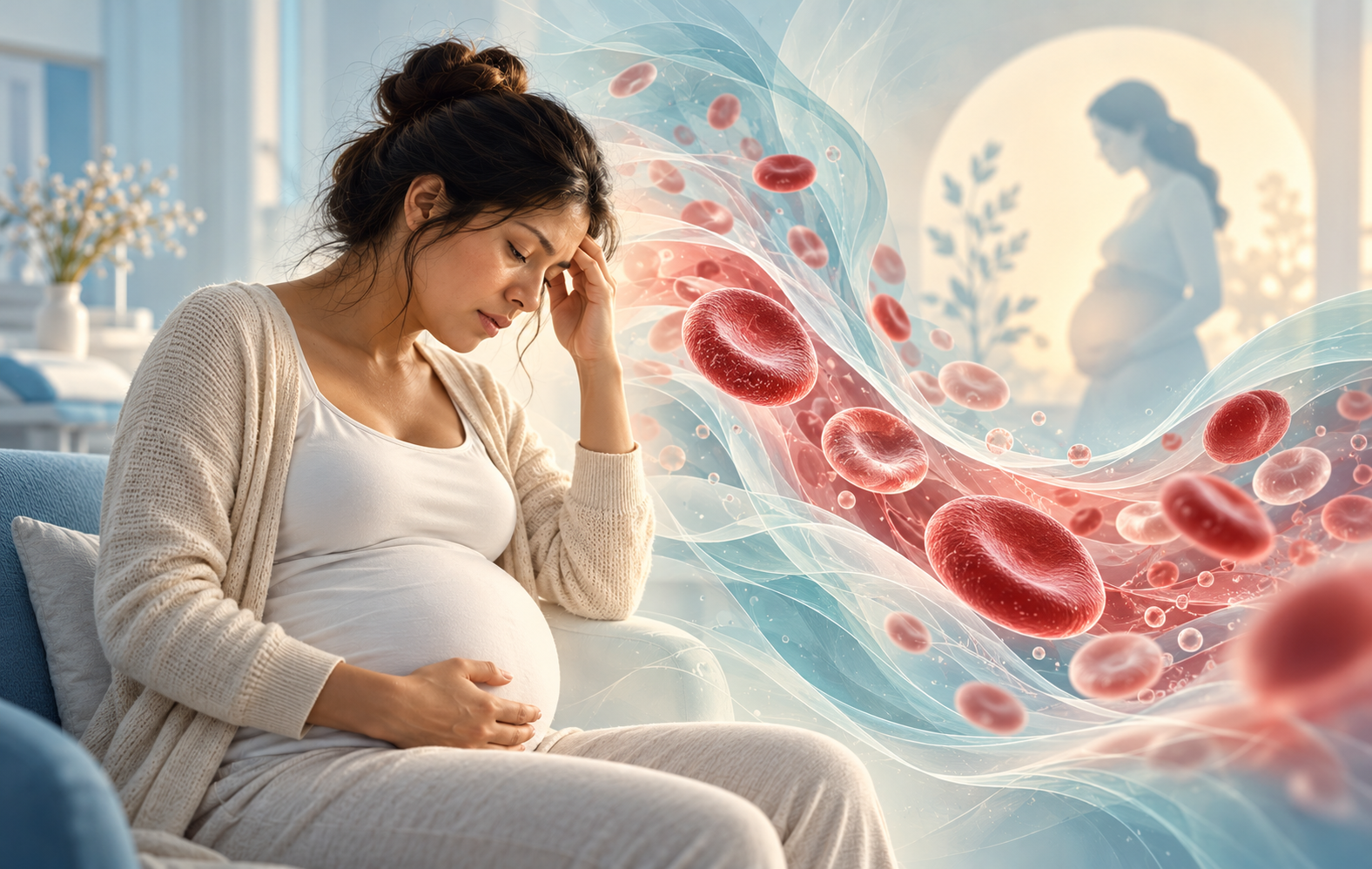
Background: Gestational anemia should be considered alongside maternal and obstetric characteristics when describing antenatal populations. Objective: To describe gestational anemia and maternal and obstetric characteristics in a selected hospital sample from Trujillo, Peru, during 2021–2024. Methods: A retrospective descriptive analysis included 319 medical records originally selected according to prelabor rupture of membranes (PROM) status: 156 women with PROM and 163 without PROM. Eligible women were aged 18–35 years and had third-trimester hemoglobin measurements and complete clinical information. Anemia severity, maternal age, body mass index, gestational age, gravidity, preeclampsia, and oligohydramnios were summarized using frequencies and percentages. Results: Anemia was documented in 160 women (50.2%): 116 (36.4% of the sample) had mild anemia, 43 (13.5%) moderate anemia, and one (0.3%) severe anemia. The largest maternal age group was 18–22 years (36.1%), and 78.7% were classified as overweight according to recorded measurements. Most women were at 38 weeks of gestation (66.8%); 60.5% were in their first pregnancy. Preeclampsia and oligohydramnios were recorded in 41.4% and 47.3%, respectively. Conclusions: Mild anemia predominated among anemia diagnoses in this selected sample. These findings characterize the hematological and obstetric profile of the selected hospital sample and support attention to anemia assessment within comprehensive antenatal care.
Descargas
Referencias
Stevens GA, Paciorek CJ, Flores-Urrutia MC, Borghi E, Namaste S, Wirth JP, et al. National, regional, and global estimates of anaemia by severity in women and children for 2000-19: a pooled analysis of population-representative data. Lancet Glob Health. 2022;10(5):e627-e639. https://doi.org/10.1016/s2214-109x(22)00084-5 DOI: https://doi.org/10.1016/S2214-109X(22)00084-5
Lewkowitz AK, Tuuli MG. Identifying and treating iron deficiency anemia in pregnancy. Hematology Am Soc Hematol Educ Program. 2023;2023(1):223-228. https://doi.org/10.1182/hematology.2023000474 DOI: https://doi.org/10.1182/hematology.2023000474
Stanley AY, Wallace JB, Hernandez AM, Spell JL. Anemia in Pregnancy: Screening and Clinical Management Strategies. MCN Am J Matern Child Nurs. 2022;47(1):25-32. https://doi.org/10.1097/nmc.0000000000000787 DOI: https://doi.org/10.1097/NMC.0000000000000787
Shi H, Chen L, Wang Y, Sun M, Guo Y, Ma S, et al. Severity of Anemia During Pregnancy and Adverse Maternal and Fetal Outcomes. JAMA Netw Open. 2022;5(2):e2147046. https://doi.org/10.1001/jamanetworkopen.2021.47046 DOI: https://doi.org/10.1001/jamanetworkopen.2021.47046
American College of Obstetricians and Gynecologists. Prelabor Rupture of Membranes: ACOG Practice Bulletin, Number 217. Obstet Gynecol. 2020;135(3):e80-e97. https://doi.org/10.1097/aog.0000000000003700 DOI: https://doi.org/10.1097/AOG.0000000000003700
Ronzoni S, Boucoiran I, Yudin MH, Coolen J, Pylypjuk C, Melamed N, et al. Guideline No. 430: Diagnosis and management of preterm prelabour rupture of membranes. J Obstet Gynaecol Can. 2022;44(11):1193-1208.e1. https://doi.org/10.1016/j.jogc.2022.08.014 DOI: https://doi.org/10.1016/j.jogc.2022.08.014
Xu L, Yang T, Wen M, Wen D, Jin C, An M, et al. Frontiers in the Etiology and Treatment of Preterm Premature Rupture of Membrane: From Molecular Mechanisms to Innovative Therapeutic Strategies. Reprod Sci. 2024;31(4):917-931. https://doi.org/10.1007/s43032-023-01411-9 DOI: https://doi.org/10.1007/s43032-023-01411-9
Young MF, Oaks BM, Rogers HP, Tandon S, Martorell R, Dewey KG, et al. Maternal low and high hemoglobin concentrations and associations with adverse maternal and infant health outcomes: an updated global systematic review and meta-analysis. BMC Pregnancy Childbirth. 2023;23(1):264. https://doi.org/10.1186/s12884-023-05489-6 DOI: https://doi.org/10.1186/s12884-023-05489-6
Wang R, Xu S, Hao X, Jin X, Pan D, Xia H, et al. Anemia during pregnancy and adverse pregnancy outcomes: a systematic review and meta-analysis of cohort studies. Front Glob Womens Health. 2025;6:1502585. https://doi.org/10.3389/fgwh.2025.1502585 DOI: https://doi.org/10.3389/fgwh.2025.1502585
Geremew H, Ali MA, Simegn MB, Golla EB, Abate A, Wondie SG, et al. Determinants of preterm prelabor rupture of fetal membrane among pregnant women in Ethiopia: A systematic review and meta-analysis. PLoS One. 2024;19(11):e0311151. https://doi.org/10.1371/journal.pone.0311151 DOI: https://doi.org/10.1371/journal.pone.0311151
Meléndez-Saravia N, Barja-Ore J. Factores de riesgo asociados con la ruptura prematura de membranas pretérmino en pacientes de un hospital del Callao, Perú. Ginecol Obstet Mex. 2020;88(1):23-28. https://doi.org/10.24245/gom.v88i1.3453 DOI: https://doi.org/10.24245/gom.v88i1.3453
Lin D, Hu B, Xiu Y, Ji R, Zeng H, Chen H, et al. Risk factors for premature rupture of membranes in pregnant women: a systematic review and meta-analysis. BMJ Open. 2024;14(3):e077727. https://doi.org/10.1136/bmjopen-2023-077727 DOI: https://doi.org/10.1136/bmjopen-2023-077727
von Elm E, Altman DG, Egger M, Pocock SJ, Gøtzsche PC, Vandenbroucke JP; STROBE Initiative. The Strengthening the Reporting of Observational Studies in Epidemiology (STROBE) statement: guidelines for reporting observational studies. PLoS Med. 2007;4(10):e296. https://doi.org/10.1371/journal.pmed.0040296 DOI: https://doi.org/10.1371/journal.pmed.0040296
World Medical Association. World Medical Association Declaration of Helsinki: ethical principles for medical research involving human subjects. JAMA. 2013;310(20):2191-2194. https://doi.org/10.1001/jama.2013.281053 DOI: https://doi.org/10.1001/jama.2013.281053
Elmore C, Ellis J. Screening, Treatment, and Monitoring of Iron Deficiency Anemia in Pregnancy and Postpartum. J Midwifery Womens Health. 2022;67(3):321-331. https://doi.org/10.1111/jmwh.13370 DOI: https://doi.org/10.1111/jmwh.13370
Ramírez-Silva I, Cantoral A, Lamadrid-Figueroa H, Christensen DL, Bygbjerg IC, Groth-Grunnet L, et al. Pre-pregnancy body mass index and gestational weight-gain predict maternal hemoglobin levels and are jointly associated with neonatal outcomes in a Mexican birth cohort. Nutr Hosp. 2022;39(4):852-862. https://doi.org/10.20960/nh.03999 DOI: https://doi.org/10.20960/nh.03999
Menon R. Fetal inflammatory response at the fetomaternal interface: A requirement for labor at term and preterm. Immunol Rev. 2022;308(1):149-167. https://doi.org/10.1111/imr.13075 DOI: https://doi.org/10.1111/imr.13075
Padron JG, Norman Ing ND, Ng PK, Kendal-Wright CE. Stretch Causes Cell Stress and the Downregulation of Nrf2 in Primary Amnion Cells. Biomolecules. 2022;12(6):766. https://doi.org/10.3390/biom12060766 DOI: https://doi.org/10.3390/biom12060766
Tong M, Smith AH, Abrahams VM. Activated Neutrophils Propagate Fetal Membrane Inflammation and Weakening through ERK and Neutrophil Extracellular Trap-Induced TLR-9 Signaling. J Immunol. 2021;206(5):1039-1045. https://doi.org/10.4049/jimmunol.2001268 DOI: https://doi.org/10.4049/jimmunol.2001268
Shahin HI, Radnaa E, Tantengco OAG, Kechichian T, Kammala AK, Sheller-Miller S, et al. Microvesicles and exosomes released by amnion epithelial cells under oxidative stress cause inflammatory changes in uterine cells. Biol Reprod. 2021;105(2):464-480. https://doi.org/10.1093/biolre/ioab088 DOI: https://doi.org/10.1093/biolre/ioab088
Finkelstein JL, Cuthbert A, Weeks J, Venkatramanan S, Larvie DY, De-Regil LM, et al. Daily oral iron supplementation during pregnancy. Cochrane Database Syst Rev. 2024;(8):CD004736. https://doi.org/10.1002/14651858.cd004736.pub6 DOI: https://doi.org/10.1002/14651858.CD004736.pub6
Descargas
Publicado
Declaración de disponibilidad de datos
The aggregate data supporting the findings are presented in the article. Further information about the data-collection form and tabulated results may be requested from the corresponding author upon reasonable request. Individual clinical records are not publicly available and remain subject to institutional authorization and confidentiality requirements.
Número
Sección
Licencia
Derechos de autor 2026 Rossana Janeth Vásquez-Verástegui (Autor/a)

Esta obra está bajo una licencia internacional Creative Commons Atribución 4.0.
Los autores conservan los derechos de autor y conceden a TUMI Health Sciences Research el derecho de primera publicación. Los artículos se publican bajo la Licencia Internacional Creative Commons Atribución 4.0 (CC BY 4.0).