Association between anxiety and temporomandibular disorders assessed by Fonseca Index in Peruvian schoolchildren: a cross-sectional study.
DOI:
https://doi.org/10.64716/wgamhy18Palabras clave:
Anxiety, Temporomandibular Joint Disorders, Adolescent, Cross-Sectional StudiesResumen
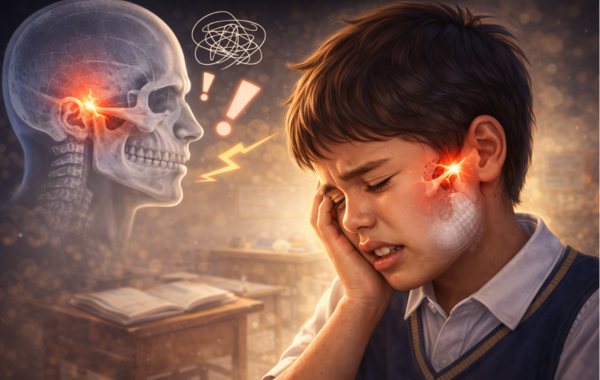
Background: Anxiety and temporomandibular disorders (TMD) are increasingly recognized as interrelated conditions, particularly in pediatric and adolescent populations, where psychosocial factors may influence musculoskeletal function. However, evidence on this association among school-aged populations remains limited in Peru. Objective: This study aimed to evaluate the association between anxiety and temporomandibular disorders assessed using the Fonseca Index in Peruvian secondary school students. Methods: A quantitative, observational, cross-sectional, non-experimental study with a correlational scope was conducted in a private educational institution. A non-probabilistic convenience sample of 92 students was selected from a total population of 120. Eligible participants were students enrolled in secondary education who provided assent and whose parents or legal guardians provided informed consent. Data were collected using the Fonseca Anamnestic Index and the Zung Self-Rating Anxiety Scale. Descriptive statistics were calculated, and the association between variables was analyzed using the chi-square test, with statistical significance set at p < 0.05. Results: Moderate anxiety was observed in 16.3% of participants, while mild TMD was identified in 40.2%. A statistically significant association was found between anxiety levels and TMD according to the Fonseca Index (p < 0.05). Conclusions: Anxiety was significantly associated with the presence of TMD in secondary school students. These findings support the incorporation of psychosocial assessment into preventive and clinical dental care for school-aged populations.
Descargas
Referencias
Alrizqi AH, Aleissa BM. Prevalence of Temporomandibular Disorders Between 2015-2021: A Literature Review. Cureus. 2023;15(4):e37028. https://doi.org/10.7759/cureus.37028
Mélou C, Sixou JL, Sinquin C, Chauvel-Lebret D. Temporomandibular disorders in children and adolescents: A review. Arch Pediatr. 2023;30(5):335-342. https://doi.org/10.1016/j.arcped.2023.03.005
Campechano L, Espinosa S, Romero T. La severidad de los trastornos temporomandibulares de acuerdo al abandono del tratamiento. Rev Odontol Latinoam. 2014;6(2):31–36. https://www.odontologia.uady.mx/revistas/rol/pdf/V06N2p31.pdf
Hurtado S, González P, Hernández C, Facio J, Aguirre J. Correlación entre trastornos temporomandibulares y ansiedad en base al índice de Fonseca y la escala de ansiedad de Hamilton. Rev Tamé. 2020;9(25):1021–1024. https://www.medigraphic.com/pdfs/tame/tam-2020/tam2025e.pdf
Tosato Jde P, Biasotto-Gonzalez DA, Gonzalez Tde O. Presence of temporomandibular joint discomfort related to pacifier use. Braz J Otorhinolaryngol. 2005;71(3):365-368. https://doi.org/10.1016/s1808-8694(15)31337-9
Valesan LF, Da-Cas CD, Réus JC, Denardin ACS, Garanhani RR, Bonotto D, et al. Prevalence of temporomandibular joint disorders: a systematic review and meta-analysis. Clin Oral Investig. 2021;25(2):441–453. https://doi.org/10.1007/s00784-020-03710-w
Visholm T, Saeed N. Current thinking in the management of temporomandibular disorders in children: a narrative review. Br J Oral Maxillofac Surg. 2024;62(10):929–936. https://doi.org/10.1016/j.bjoms.2024.09.004
Dym H, Israel H. Diagnosis and treatment of temporomandibular disorders. Dent Clin North Am. 2012;56(1):149-ix. https://doi.org/10.1016/j.cden.2011.08.002
Leon-Rodriguez JA, Espinoza-Salcedo M, Gutierrez-Polanco YM, Aquepucho-Bellota RW, Leon-Rodriguez JD, Leon-Plasencia JL. Translation and validation of the OHIP-14 Oral Health Impact Profile into the Quechua language of Peru. Braz Oral Res. 2025;39:e098. https://doi.org/10.1590/1807-3107bor-2025.vol39.098
Al-Khotani A, Naimi-Akbar A, Gjelset M, et al. The associations between psychosocial aspects and TMD-pain related aspects in children and adolescents. J Headache Pain. 2016;17:30. https://doi.org/10.1186/s10194-016-0622-0
Hernández R, Fernández C, Baptista P. Metodología de la investigación. 6th ed. México: McGraw-Hill Education; 2014.
Stasiak G, Maracci LM, de Oliveira Chami V, et al. TMD diagnosis: Sensitivity and specificity of the Fonseca Anamnestic Index. Cranio. 2023;41(3):199-203. https://doi.org/10.1080/08869634.2020.1839724
Restrepo C, Ortiz AM, Henao AC, Manrique R. Association between psychological factors and temporomandibular disorders in adolescents of rural and urban zones. BMC Oral Health. 2021;21(1):140. https://doi.org/10.1186/s12903-021-01485-4
Al-Khotani A, Meisha DE, Al Sayegh S, Hedenberg-Magnusson B, Ernberg M, Christidis N. The Association Between Psychological Symptoms and Self-Reported Temporomandibular Disorders Pain Symptoms in Children and Adolescents. Front Oral Health. 2021;2:675709. https://doi.org/10.3389/froh.2021.675709
Nilsson IM, Ekberg E, Michelotti A, et al. Diagnostic criteria for temporomandibular disorders-INfORM recommendations: Comprehensive and short-form adaptations for children. J Oral Rehabil. 2023;50(2):99-112. https://doi.org/10.1111/joor.13390
Navarro L, Manzano L, Pichs J, Nápoles N. Relación de trastornos temporomandibulares con la ansiedad y hábitos parafuncionales. Rev Electrónica Dr Zoilo E Marinello Vidaurreta. 2019;44(1). https://revzoilomarinello.sld.cu/index.php/zmv/article/view/1581
Mehdipour A, Khosroshahian S, Pourhossein H, Mohammadbeigi A, Karimi A. Prevalence and association of temporomandibular disorders with malocclusion and anxiety in children and adolescents: a cross-sectional observational study. Gen Dent. 2022;70(3):65-71. https://pubmed.ncbi.nlm.nih.gov/35467547/
Karibe H, Shimazu K, Okamoto A, Kawakami T, Kato Y, Warita-Naoi S. Prevalence and association of self-reported anxiety, pain, and oral parafunctional habits with temporomandibular disorders in Japanese children and adolescents: a cross-sectional survey. BMC Oral Health. 2015;15:8. https://doi.org/10.1186/1472-6831-15-8
Minervini G, Franco R, Marrapodi MM, Fiorillo L, Cervino G, Cicciù M. Prevalence of temporomandibular disorders in children and adolescents evaluated with Diagnostic Criteria for Temporomandibular Disorders: A systematic review with meta-analysis. J Oral Rehabil. 2023;50(6):522-530. https://doi.org/10.1111/joor.13446
Castillo G, Medina J, Medina I, Yam A, Candila J, Gazca S. Trastorno temporomandibular relacionada con Ansiedad en adolescentes de una zona suburbana de Yucatán, México. Cienc Humanismo Salud. 2018;5(1):2–8. https://revistacienciayhumanismoenlasalud.uady.mx/cienciayhumanismo/article/view/89
Descargas
Publicado
Declaración de disponibilidad de datos
The datasets generated and/or analyzed during the current study are not publicly available due to confidentiality and ethical restrictions but are available from the corresponding author upon reasonable request.
Número
Sección
Categorías
Licencia
Derechos de autor 2026 Anali Gamboa-Dominguez, Jherson David Leon-Rodriguez (Autor/a)

Esta obra está bajo una licencia internacional Creative Commons Atribución 4.0.
Authors retain the copyright of their work and grant TUMI Oral Health the right of first publication. Articles are published under the Creative Commons Attribution 4.0 International License (CC BY 4.0), which permits unrestricted use, distribution, and reproduction in any medium, provided that the original work is properly cited.