Antibacterial effect of hydroethanolic extracts of Mentha piperita and Cymbopogon citratus against Streptococcus mutans ATCC 25175: In vitro study.
DOI:
https://doi.org/10.64716/4n8c6d42Palabras clave:
Mentha piperita, Cymbopogon citratus, Streptococcus mutans, Antibacterial Agents, Plant Extracts, Dental CariesResumen
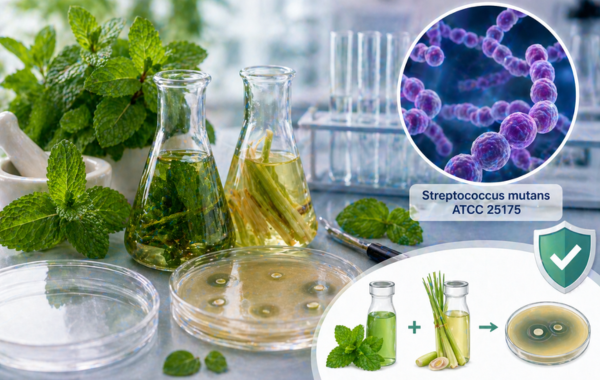
Dental caries remains one of the most prevalent oral diseases worldwide, primarily associated with the activity of Streptococcus mutans. The search for natural antimicrobial agents has gained increasing attention due to their potential effectiveness and reduced adverse effects compared to conventional agents. This study aimed to evaluate the antibacterial effect of hydroethanolic extracts of Mentha piperita and Cymbopogon citratus, individually and in combination, against Streptococcus mutans ATCC 25175. An in vitro experimental, prospective, and analytical study was conducted using 50 Petri dishes distributed into five groups: hydroethanolic extract of Mentha piperita, Cymbopogon citratus, their combination, 0.12% chlorhexidine gluconate (positive control), and a negative control. All groups were exposed to a standardized bacterial suspension of 1.5 × 10⁸ CFU/mL. Antibacterial activity was assessed by measuring inhibition zones using a calibrated Vernier caliper. The combination of extracts at 100% concentration showed the highest antibacterial effect with a mean inhibition zone of 18.8 mm, while individual extracts of Cymbopogon citratus and Mentha piperita both showed inhibition zones of 16.1 mm. Statistical analysis using ANOVA revealed significant differences among groups (p < 0.05). The findings suggest that the combined use of Mentha piperita and Cymbopogon citratus hydroethanolic extracts exhibits enhanced antibacterial activity against Streptococcus mutans, indicating their potential as alternative agents for the prevention of dental caries.
Descargas
Referencias
GBD 2021 Oral Disorders Collaborators. Trends in the global, regional, and national burden of oral conditions from 1990 to 2021: a systematic analysis for the Global Burden of Disease Study 2021. Lancet. 2025;405(10482):897-910. https://doi.org/10.1016/S0140-6736(24)02811-3 DOI: https://doi.org/10.1016/S0140-6736(24)02811-3
Ribeiro AA, Paster BJ. Dental caries and their microbiomes in children: what do we do now? J Oral Microbiol. 2023;15(1):2198433. https://doi.org/10.1080/20002297.2023.2198433 DOI: https://doi.org/10.1080/20002297.2023.2198433
Gao Z, Chen X, Wang C, Song J, Xu J, Liu X, et al. New strategies and mechanisms for targeting Streptococcus mutans biofilm formation to prevent dental caries: A review. Microbiol Res. 2024;278:127526. https://doi.org/10.1016/j.micres.2023.127526 DOI: https://doi.org/10.1016/j.micres.2023.127526
Zhu Y, Wang Y, Zhang C, Li M, Li Y, Ying X, et al. Association of polymicrobial interactions with dental caries development and prevention. Front Microbiol. 2023;14:1196619. https://doi.org/10.3389/fmicb.2023.1162380 DOI: https://doi.org/10.3389/fmicb.2023.1162380
Deus FP, Ouanounou A. Chlorhexidine in dentistry: Pharmacology, uses, and adverse effects. Int Dent J. 2022;72(3):269-277. https://doi.org/10.1016/j.identj.2022.01.005 DOI: https://doi.org/10.1016/j.identj.2022.01.005
James P, Worthington HV, Parnell C, Harding M, Lamont T, Cheung A, et al. Chlorhexidine mouthrinse as an adjunctive treatment for gingival health. Cochrane Database Syst Rev. 2017;(3):CD008676. https://doi.org/10.1002/14651858.CD008676.pub2 DOI: https://doi.org/10.1002/14651858.CD008676.pub2
Karygianni L, Al-Ahmad A, Argyropoulou A, Hellwig E, Anderson AC, Skaltsounis AL. Natural antimicrobials and oral microorganisms: A systematic review on herbal interventions for the eradication of multispecies oral biofilms. Front Microbiol. 2016;6:1529. https://doi.org/10.3389/fmicb.2015.01529 DOI: https://doi.org/10.3389/fmicb.2015.01529
Milho C, Silva J, Guimarães R, Ferreira ICFR, Barros L, Alves MJ. Antimicrobials from medicinal plants: An emergent strategy to control oral biofilms. Appl Sci. 2021;11(9):4020. https://doi.org/10.3390/app11094020 DOI: https://doi.org/10.3390/app11094020
Cardoso VFdS, Roppa RHA, Antunes C, Moraes ANS, Santi L, Konrath EL. Efficacy of medicinal plant extracts as dental and periodontal antibiofilm agents: A systematic review of randomized clinical trials. J Ethnopharmacol. 2021;281:114541. https://doi.org/10.1016/j.jep.2021.114541 DOI: https://doi.org/10.1016/j.jep.2021.114541
Madhavan SS, Sreedevi PV, Varghese M, Joseph A, et al. Effectiveness of Mentha piperita leaf extracts against oral pathogens: An in vitro study. J Contemp Dent Pract. 2018;19(9):1042-1046. https://doi.org/10.5005/jp-journals-10024-2378 DOI: https://doi.org/10.5005/jp-journals-10024-2378
Ashrafi B, Rashidipour M, Marzban A, Soroush S, Azadpour M, Delfani S, et al. Mentha piperita essential oils loaded in a chitosan nanogel with inhibitory effect on biofilm formation against S. mutans on the dental surface. Carbohydr Polym. 2019;212:142-149. https://doi.org/10.1016/j.carbpol.2019.02.018 DOI: https://doi.org/10.1016/j.carbpol.2019.02.018
Mostafa DA, Bayoumi FS, Taher HM, Abdelmonem BH, Eissa TF. Antimicrobial potential of Mentha spp. essential oils as raw and loaded solid lipid nanoparticles against dental caries. Res J Pharm Technol. 2020;13(9):4415-4422. https://doi.org/10.5958/0974-360X.2020.00781.7 DOI: https://doi.org/10.5958/0974-360X.2020.00781.7
Tofiño-Rivera A, Ortega-Cuadros M, Galvis-Pareja D, Jiménez-Rios H, Merini LJ, Martínez-Pabón MC. Effect of Lippia alba and Cymbopogon citratus essential oils on biofilms of Streptococcus mutans and cytotoxicity in CHO cells. J Ethnopharmacol. 2016;194:749-754. https://doi.org/10.1016/j.jep.2016.10.044 DOI: https://doi.org/10.1016/j.jep.2016.10.044
Oliveira MAC, Borges AC, Brighenti FL, Salvador MJ, Gontijo AVL, Koga-Ito CY. Cymbopogon citratus essential oil: effect on polymicrobial caries-related biofilm with low cytotoxicity. Braz Oral Res. 2017;31:e89. https://doi.org/10.1590/1807-3107BOR-2017.vol31.0089 DOI: https://doi.org/10.1590/1807-3107bor-2017.vol31.0089
Mouta LFGL, Marques RS, Antunes AÁ, de Oliveira Lima E, de Souza EL, Ricomini-Filho AP. Cymbopogon citratus essential oil increases the effect of digluconate chlorhexidine on microcosm biofilms. Pathogens. 2022;11(10):1067. https://doi.org/10.3390/pathogens11101067 DOI: https://doi.org/10.3390/pathogens11101067
Pallavi P, Sahoo PP, Sen SK, Raut S. Comparative evaluation of anti-biofilm and anti-adherence potential of plant extracts against Streptococcus mutans: A therapeutic approach for oral health. Microb Pathog. 2024;188:106514. https://doi.org/10.1016/j.micpath.2023.106514 DOI: https://doi.org/10.1016/j.micpath.2023.106514
Balouiri M, Sadiki M, Ibnsouda SK. Methods for in vitro evaluating antimicrobial activity: A review. J Pharm Anal. 2016;6(2):71-79. https://doi.org/10.1016/j.jpha.2015.11.005 DOI: https://doi.org/10.1016/j.jpha.2015.11.005
World Medical Association. World Medical Association Declaration of Helsinki: Ethical principles for medical research involving human subjects. JAMA. 2013;310(20):2191-2194. https://doi.org/10.1001/jama.2013.281053 DOI: https://doi.org/10.1001/jama.2013.281053
Nostro A, Blanco AR, Cannatelli MA, et al. Susceptibility of methicillin-resistant staphylococci to oregano essential oil, carvacrol and thymol. FEMS Microbiol Lett. 2004;230(2):191–195. https://doi.org/10.1016/S0378-1097(03)00890-5 DOI: https://doi.org/10.1016/S0378-1097(03)00890-5
Bassolé IHN, Juliani HR. Essential oils in combination and their antimicrobial properties. Molecules. 2012;17(4):3989–4006. https://doi.org/10.3390/molecules17043989 DOI: https://doi.org/10.3390/molecules17043989
Burt S.Essential oils: their antibacterial properties and potential applications in foods.Int J Food Microbiol. 2004;94(3):223–253. https://doi.org/10.1016/j.ijfoodmicro.2004.03.022 DOI: https://doi.org/10.1016/j.ijfoodmicro.2004.03.022
Langeveld WT, Veldhuizen EJA, Burt SA.Synergy between essential oil components and antibiotics.Crit Rev Microbiol. 2014;40(1):76–94. https://doi.org/10.3109/1040841X.2013.763219 DOI: https://doi.org/10.3109/1040841X.2013.763219
Descargas
Publicado
Declaración de disponibilidad de datos
The datasets generated and/or analyzed during the current study are not publicly available due to confidentiality and ethical restrictions but are available from the corresponding author upon reasonable request.
Número
Sección
Categorías
Licencia
Derechos de autor 2026 Carlos Edilberto Benites-Flores, Rossemarie Jetzabel Loaiza-Molina (Autor/a)

Esta obra está bajo una licencia internacional Creative Commons Atribución 4.0.
Authors retain the copyright of their work and grant TUMI Oral Health the right of first publication. Articles are published under the Creative Commons Attribution 4.0 International License (CC BY 4.0), which permits unrestricted use, distribution, and reproduction in any medium, provided that the original work is properly cited.