Prevalence and distribution of developmental dental anomalies on panoramic radiographs of adults from Ica and Huamanga, Peru, 2021–2023: a retrospective cross-sectional study
DOI:
https://doi.org/10.64716/0vwqmw50Keywords:
Tooth Abnormalities, Panoramic Radiography, Prevalence, Adult, PeruAbstract
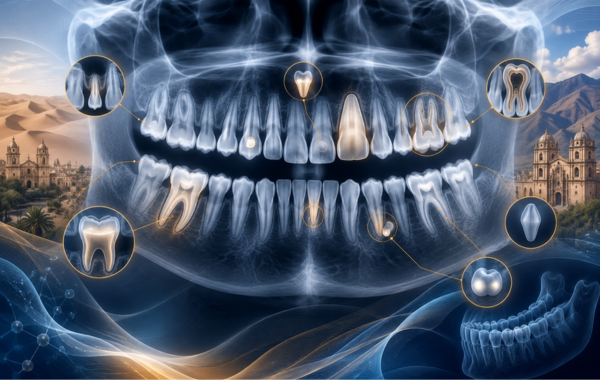
Background: Developmental dental anomalies may affect diagnosis, occlusion, esthetics, treatment planning, and long-term oral health. Their prevalence varies among populations, but evidence in Peruvian adults remains limited. Objective: This study aimed to determine the prevalence and distribution of developmental dental anomalies observed on panoramic radiographs of adults from Ica and Huamanga, Peru, between 2021 and 2023. Methods: A retrospective cross-sectional study was conducted using 646 panoramic radiographs of adults aged 20 to 50 years. Dental anomalies were classified according to alterations in tooth shape, size, and number through radiographic observation. Data were analyzed using absolute and relative frequencies. Results: Developmental dental anomalies were identified in 38.5% of radiographs. Shape anomalies were the most frequent category (16.6%), followed by size anomalies (15.6%) and number anomalies (6.3%). No developmental dental anomalies were observed in 61.5% of radiographs. Conclusions: Developmental dental anomalies were frequent among adults from Ica and Huamanga, with shape anomalies being the most common finding. These results support the usefulness of panoramic radiographs for identifying dental anomalies and improving clinical decision-making in adult dental care.
Downloads
References
World Health Organization. Global oral health status report: towards universal health coverage for oral health by 2030. Geneva: World Health Organization; 2022. https://www.who.int/publications/i/item/9789240061484
Rivera Cruz AM, Artigas Alonso A, Buitrago Pavón E, Viguera Prieto Y. Prevalencia y factores de riesgo de caries dental en pacientes del municipio Urbano Noris. Correo Científico Médico. 2017;21(1):139-154. https://scielo.sld.cu/scielo.php?pid=S1560-43812017000100012&script=sci_arttext
Ministerio de Salud del Perú. El 90.4% de los peruanos tiene caries dental. Lima: Ministerio de Salud; 2019. https://www.gob.pe/institucion/minsa/noticias/45475-el-90-4-de-los-peruanos-tiene-caries-dental
Aliaga-Del Castillo A, Mattos-Vela MA, Aliaga-Del Castillo R, Del Castillo-Mendoza C. Maloclusiones en niños y adolescentes de caseríos y comunidades nativas de la Amazonía de Ucayali, Perú. Rev Peru Med Exp Salud Publica. 2011;28(1):87-91. http://www.scielo.org.pe/scielo.php?script=sci_arttext&pid=S1726-46342011000100014
Vicente Ramos NP, Silva-Esteves Raffo JF, León-Manco RA. Frecuencia de hábitos orales y alteraciones dentoalveolares en niños de 7 a 12 años de edad en un centro dental docente de Lima-Perú. Estudio retrospectivo. Odontol Pediatr. 2022;21(1):12-22. https://op.spo.com.pe/index.php/odontologiapediatrica/article/view/201
Espinal-Botero G, Manco-Guzmán HA, Aguilar-Méndez G, Castrillón-Pino L, Rendón-Giraldo JE, Marín-Botero ML. Retrospective study of dental anomalies and bone alterations of the maxilla and mandible in children 5 to 14 years of age from the clinics of the College of Dentistry, University of Antioquia. Rev Fac Odontol Univ Antioq. 2009;21(1):50-64. https://doi.org/10.17533/udea.rfo.2174
Vélez-Estrada D, Quiceno-Cortés S, Trujillo-Peña AM, Henao-Bustamante E, Londoño-González MC, Ortiz LM, et al. Alteraciones y anomalías dentales: forma, tamaño y número. Rev CES Odontol. 2015;28(1):63-77. https://repository.ces.edu.co/items/b41ec7d7-9747-4429-9b3f-38d3a7e46567
Shrestha A, Marla V, Shrestha S, Maharjan IK. Developmental anomalies affecting the morphology of teeth: a review. RSBO. 2015;12(1):68-78. https://doi.org/10.21726/rsbo.v12i1.732
Wong SW, Liu HC, Han D, Chang HG, Zhao HS, Wang YX, et al. A novel non-stop mutation in MSX1 causing autosomal dominant non-syndromic oligodontia. Mutagenesis. 2014;29(5):319-323. https://doi.org/10.1093/mutage/geu026
Abdalla EM, Mostowska A, Jagodziński PP, Dwidar K, Ismail SR. A novel WNT10A mutation causes non-syndromic hypodontia in an Egyptian family. Arch Oral Biol. 2014;59(7):722-728. https://doi.org/10.1016/j.archoralbio.2014.04.004
Marañón-Vásquez GA, Vieira AR, Santos LV, Cunha AS, Weiss SG, Araujo MT, et al. FGF10 and FGF13 genetic variation and tooth-size discrepancies. Angle Orthod. 2021;91(3):356-362. https://doi.org/10.2319/060920-531.1
Marçal FF, Ribeiro EM, Costa FWG, Fonteles CSR, Teles GS, Silva PGB, et al. Dental alterations on panoramic radiographs of patients with osteogenesis imperfecta in relation to clinical diagnosis, severity, and bisphosphonate regimen aspects: a STROBE-compliant case-control study. Oral Surg Oral Med Oral Pathol Oral Radiol. 2019;128(6):621-630. https://doi.org/10.1016/j.oooo.2019.07.001
Hajmohammadi E, Najirad S, Mikaeili H, Kamran A. Epidemiology of supernumerary teeth in 5000 radiography films: investigation of patients referring to the clinics of Ardabil in 2015-2020. Int J Dent. 2021;2021:6669436. https://doi.org/10.1155/2021/6669436
Kolokitha OE, Balli D, Zarkadi AE, Gizani S. Association between maxillary canine impaction and other dental anomalies: radiological study of a mixed dentition children’s cohort from an orthodontic clinic. Eur Arch Paediatr Dent. 2023;24(4):401-407. https://doi.org/10.1007/s40368-023-00798-y
Miranda-Medina A. Agenesis of third molars and its association with other dental anomalies in a Peruvian population. J Oral Res. 2020;9(3):166-170. https://doi.org/10.17126/joralres.2020.032
Sánchez-Tito MA, Vargas-García R. Prevalence and patterns of supernumerary teeth in a Peruvian non-syndromic population: a radiographic study. Int J Odontostomat. 2022;16(3):364-369. https://doi.org/10.4067/S0718-381X2022000300364
Palacios León C, Cárdenas Flores C. Prevalencia de anomalías dentarias de tamaño y forma en pacientes pediátricos de 6 a 17 años de la ciudad de Huánuco, 2019-2022. Rev Cient Odontol (Lima). 2023;11(4):e171. https://doi.org/10.21142/2523-2754-1104-2023-171
Cordero-Ortiz P, Guerrero-Ortiz F, Aspiazu-Hinostroza K. Dientes supernumerarios: reporte de un caso. Av Odontoestomatol. 2022;38(4):151-155. https://doi.org/10.4321/s0213-12852022000400004
Karadas M, Celikoglu M, Akdag MS. Evaluation of tooth number anomalies in a subpopulation of the North-East of Turkey. Eur J Dent. 2014;8(3):337-341. https://doi.org/10.4103/1305-7456.137641
Colak H, Uzgur R, Tan E, Hamidi MM, Turkal M, Colak T. Investigation of prevalence and characteristics of mesiodens in a non-syndromic 11256 dental outpatients. Eur Rev Med Pharmacol Sci. 2013;17(19):2684-2689. https://pubmed.ncbi.nlm.nih.gov/24142619/
Jafarian M, Nazemi B, Bargrizan M, Ramezani J, Ansari G. Sequential supernumerary teeth development in a non-syndromic patient: report of a rare case. J Dent (Tehran). 2013;10(6):554-561. https://pmc.ncbi.nlm.nih.gov/articles/PMC4064291/
More CB, Tailor MN. Tooth fusion, a rare dental anomaly: analysis of six cases. Int J Oral Maxillofac Pathol. 2013;4(1):50-53. https://go.gale.com/ps/i.do?id=GALE%7CA347970338
Shrivastava S, Tijare M, Singh S. Fusion/double teeth. J Indian Acad Oral Med Radiol. 2011;23(Suppl 1):S468-S470. https://doi.org/10.5005/jp-journals-10011-1200
Santos KSA, Lins CCSA, Almeida-Gomes F, Travassos RMC, Santos RA. Anatomical aspects of permanent geminate superior central incisives. Int J Morphol. 2009;27(2):515-517. http://www.intjmorphol.com/wp-content/uploads/2021/04/art_34_272.pdf
Tannenbaum KA, Alling EE. Anomalous tooth development: case reports of gemination and twinning. Oral Surg Oral Med Oral Pathol. 1963;16:883-887. https://doi.org/10.1016/0030-4220(63)90326-8
Knežević A, Travan S, Tarle Z, Šutalo J, Janković B, Ciglar I. Double tooth. Coll Antropol. 2002;26(2):667-672. https://pubmed.ncbi.nlm.nih.gov/12528297/
Guimarães Cabral LA, Firoozmand LM, Dias Almeida J. Double teeth in primary dentition: report of two clinical cases. Med Oral Patol Oral Cir Bucal. 2008;13(1):E77-E80. https://pubmed.ncbi.nlm.nih.gov/18167487/
Darwazeh A, Hamasha AA. Radiographic evidence of enamel pearls in Jordanian dental patients. Oral Surg Oral Med Oral Pathol Oral Radiol Endod. 2000;89(2):255-258. https://doi.org/10.1067/moe.2000.103524
Risnes S. The prevalence, location, and size of enamel pearls on human molars. Scand J Dent Res. 1974;82(6):403-412. https://pubmed.ncbi.nlm.nih.gov/4530804/
Goldstein AR. Enamel pearls as a contributing factor in periodontal breakdown. J Am Dent Assoc. 1979;99(2):210-211. https://pubmed.ncbi.nlm.nih.gov/287723/
Atkinson SR. The permanent maxillary lateral incisor. Am J Orthod Oral Surg. 1943;29(12):685-698. https://www.ajodo.org/article/S0096-6347(00)X0052-X/fulltext
Karjodkar FR, Mali S, Sontakke S, Sansare K, Patil DJ. Five developmental anomalies in a single patient: a rare case report. J Clin Diagn Res. 2012;6(9):1603-1605. https://doi.org/10.7860/JCDR/2012/4174.2576
Oehlers FA, Lee KW, Lee EC. Dens evaginatus (evaginated odontome): its structure and responses to external stimuli. Dent Pract Dent Rec. 1967;17(7):239-244. https://pubmed.ncbi.nlm.nih.gov/5226881/
Gomes RR, Habckost CD, Junqueira LG, Leite AF, Figueiredo PT, Paula LM, et al. Taurodontism in Brazilian patients with tooth agenesis and first- and second-degree relatives: a case-control study. Arch Oral Biol. 2012;57(8):1062-1069. https://doi.org/10.1016/j.archoralbio.2012.04.006
Kan WY, Seow WK, Holcombe T. Taurodontism in children with hypodontia and supernumerary teeth: a case control study. Pediatr Dent. 2010;32(2):134-140. https://pubmed.ncbi.nlm.nih.gov/20483017/
Morales-Chávez MC, Nualart-Grollmus ZC, Silvestre FJ. Clinical prevalence of oral soft tissue lesions in patients with Down syndrome. Med Oral Patol Oral Cir Bucal. 2014;19(5):e446-e450. https://doi.org/10.4317/medoral.19570
Bogale B, Engida F, Hanlon C, Prince MJ, Gallagher JE. Dental caries experience and associated factors in adults: a cross-sectional community survey within Ethiopia. BMC Public Health. 2021;21:180. https://doi.org/10.1186/s12889-021-10199-9
Caye LFS, Kopplin DC, da Fontoura Frasca LC, Rivaldo EG, Celeste RK. Prevalência e severidade do desgaste dentário e fatores de risco entre adultos jovens no sul do Brasil. Rev Fac Odontol Porto Alegre. 2020;61(1):36-45. https://doi.org/10.22456/2177-0018.99642
Suarez-Rojas YS, Romero-Gamboa JC, La Serna-Solari PB. Prevalencia de enfermedades de la mucosa oral, registradas entre 2014-2018 en un hospital docente en Perú. Horiz Sanit. 2022;21(1):121-127. https://doi.org/10.19136/hs.a21n1.4604
Reátegui-Navarro M, Chanamé-Marín A, Arbildo-Vega H. Prevalence of dental paleopathology in a Peruvian pre-Hispanic population. J Oral Res. 2019;8(2):147-151. https://doi.org/10.17126/joralres.2019.023
Rojas HI. Prevalencia de caries dental y factores de riesgo asociados. Rev Cub Med Mil. 2012;41(4):379-384. https://revmedmilitar.sld.cu/index.php/mil/article/view/108
Morales Miranda L, Gómez Gonzáles W. Caries dental y sus consecuencias clínicas relacionadas al impacto en la calidad de vida de preescolares de una escuela estatal. Rev Estomatol Herediana. 2019;29(1):17-29. https://doi.org/10.20453/reh.v29i1.3491
Navarro M. Prevalencia de caries dental en niños y factores asociados. Ocronos. 2023;6(7):151. https://revistamedica.com/prevalencia-caries-dental-ninos-factores-asociados
Ceroni Galloso M. ¿Investigación básica, aplicada o sólo investigación? Rev Soc Quím Perú. 2010;76(1):5-6. http://www.scielo.org.pe/scielo.php?script=sci_arttext&pid=S1810-634X2010000100001
Ochoa J, Yunkor Y. El estudio descriptivo en la investigación científica. Acta Jurídica Peruana. 2019;2(2). http://revistas.unp.edu.pe/index.php/actajuridica/article/view/120
Cvetkovic-Vega A, Maguiña JL, Soto A, Lama-Valdivia J, Correa-López LE. Estudios transversales. Rev Fac Med Hum. 2021;21(1):179-185. https://doi.org/10.25176/RFMH.v21i1.3069
Corona Martínez LA, Fonseca Hernández M. Acerca del carácter retrospectivo o prospectivo en la investigación científica. Medisur. 2021;19(2):338-341. http://scielo.sld.cu/scielo.php?script=sci_arttext&pid=S1727-897X2021000200338
von Elm E, Altman DG, Egger M, Pocock SJ, Gøtzsche PC, Vandenbroucke JP; STROBE Initiative. The Strengthening the Reporting of Observational Studies in Epidemiology (STROBE) Statement: guidelines for reporting observational studies. Ann Intern Med. 2007;147(8):573-577. https://doi.org/10.7326/0003-4819-147-8-200710160-00010
Reverte-Salazar MG, Rosales-Berber MA, Pozos-Guillén AJ, Garrocho-Rangel JA, Torre-Delgadillo A, Esparza-Villalpando V. Correlación entre la edad cronológica y dental con los estadios de maduración vertebral en pacientes de 5 a 15 años. Int J Morphol. 2019;37(2):548-553. http://www.scielo.cl/scielo.php?script=sci_arttext&pid=S0717-95022019000200548
Nakata M, Wei SHY. Guía oclusal en odontopediatría. Fukota, Japón: Actualidades Médico Odontológicas Latinoamérica; 1992.
Schrieber A, Alsabban L, Fulmer T, Glickman R. Geriatric dentistry: maintaining oral health in the geriatric population. In: Fillit HM, Rockwood K, Young J, editors. Brocklehurst's Textbook of Geriatric Medicine and Gerontology. 8th ed. Philadelphia: Elsevier; 2017. Chapter 110.
World Medical Association. World Medical Association Declaration of Helsinki: ethical principles for medical research involving human subjects. JAMA. 2013;310(20):2191-2194. https://doi.org/10.1001/jama.2013.281053
Inguillay Gagñay LK, Tercero Chicaiza SL, López Aguirre J. Ética en la investigación científica. Imaginario Social. 2020;3(1). https://www.revista-imaginariosocial.com/index.php/es/article/view/10
García San Juan CM, García Núñez RD, San Juan Bosch MA. Clasificación de las condiciones y enfermedades periodontales y periimplantarias desde una perspectiva evolutiva. Medisur. 2021;19(4):642-655. http://scielo.sld.cu/scielo.php?script=sci_arttext&pid=S1727-897X2021000400642
Pindborg JJ. Pathology of the Dental Hard Tissues. Philadelphia: WB Saunders; 1970.
Downloads
Published
Data Availability Statement
The data supporting the findings of this study are not publicly available because they contain clinical records subject to institutional confidentiality requirements. However, anonymized data may be obtained from the corresponding author upon reasonable request and with permission from the participating institution.
License
Copyright (c) 2026 Eylim Edir Montero-Betalleluz (Autor/a)

This work is licensed under a Creative Commons Attribution 4.0 International License.
Authors retain the copyright of their work and grant TUMI Oral Health the right of first publication. Articles are published under the Creative Commons Attribution 4.0 International License (CC BY 4.0), which permits unrestricted use, distribution, and reproduction in any medium, provided that the original work is properly cited.