Flexural and compressive strength of bis-acryl, polymethyl methacrylate, and 3D-printed provisional resins: a comparative in vitro study
DOI:
https://doi.org/10.64716/ahbxdg78Keywords:
Dental Materials, Polymethyl Methacrylate, Composite Resins, Flexural Strength, Compressive StrengthAbstract
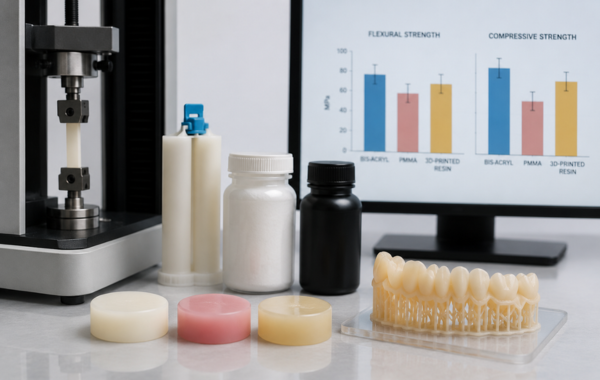
Background: Provisional restorations must maintain adequate mechanical integrity during treatment, particularly when subjected to bending and occlusal forces. Objective: To compare the flexural and compressive strengths of a bis-acryl resin, an autopolymerizing polymethyl methacrylate (PMMA) resin, and a 3D-printed provisional resin. Methods: A comparative experimental in vitro study was conducted using 54 specimens, with 18 specimens assigned to each material. For each group, nine specimens were evaluated for flexural strength and nine for compressive strength. After storage in distilled water at 37 °C for 24 hours, flexural strength was assessed using a three-point bending test and compressive strength by axial loading in a universal testing machine. Results: Significant differences were found among the materials for flexural strength (F = 6.104; p = 0.007) and compressive strength (F = 20.750; p = 0.000). The bis-acryl resin showed the highest mean flexural strength (69.46 ± 7.70 MPa), followed by the 3D-printed resin (60.92 ± 3.54 MPa) and PMMA (57.04 ± 10.36 MPa). It also showed the highest mean compressive strength (82.25 ± 14.79 MPa), followed by the 3D-printed resin (75.96 ± 5.62 MPa) and PMMA (51.30 ± 9.89 MPa). Flexural strength differed significantly between the bis-acryl resin and both PMMA and the 3D-printed resin, whereas compressive strength differed significantly between PMMA and the other two materials. Conclusion: Under the conditions of this study, the bis-acryl resin demonstrated the most favorable overall mechanical performance, while the 3D-printed resin showed compressive strength comparable to that of the bis-acryl resin.
Downloads
References
Shillingburg HT Jr, Hobo S, Whitsett LD, Jacobi R, Brackett SE. Fundamentals of Fixed Prosthodontics. 3rd ed. Quintessence Publishing Co; 1997. https://search.worldcat.org/title/Fundamentals-of-fixed-prosthodontics/oclc/34906129
Prasad KD, Shetty M, Alva H, Prasad AD. Provisional restorations in prosthodontic rehabilitations: concepts, materials and techniques. J Health Allied Sci NU. 2012;2(2):72-77. https://doi.org/10.1055/s-0040-1703578 DOI: https://doi.org/10.1055/s-0040-1703578
Alt V, Hannig M, Wöstmann B, Balkenhol M. Fracture strength of temporary fixed partial dentures: CAD/CAM versus directly fabricated restorations. Dent Mater. 2011;27(4):339-347. https://doi.org/10.1016/j.dental.2010.11.012 DOI: https://doi.org/10.1016/j.dental.2010.11.012
Mehrpour H, Farjood E, Giti R, Barfi Ghasrdashti A, Heidari H. Evaluation of the flexural strength of interim restorative materials in fixed prosthodontics. J Dent (Shiraz). 2016;17(3):201-206. https://pmc.ncbi.nlm.nih.gov/articles/PMC5006829/
Al Idrissi H, Annamma LM, Sharaf D, Al Jaghsi A, Abutayyem H. Comparative evaluation of flexural strength of four different types of provisional restoration materials: an in vitro pilot study. Children (Basel). 2023;10(2):380. https://doi.org/10.3390/children10020380 DOI: https://doi.org/10.3390/children10020380
Jain S, Sayed ME, Shetty M, Alqahtani SM, Al Wadei MHD, Gupta SG, et al. Physical and mechanical properties of 3D-printed provisional crowns and fixed dental prosthesis resins compared with CAD/CAM-milled and conventional provisional resins: a systematic review and meta-analysis. Polymers (Basel). 2022;14(13):2691. https://doi.org/10.3390/polym14132691 DOI: https://doi.org/10.3390/polym14132691
Çakmak G, Yilmaz H, Aydoğ Ö, Yilmaz B. Flexural strength of CAD-CAM and conventional interim resin materials with a surface sealant. J Prosthet Dent. 2020;124(6):800.e1-800.e7. https://doi.org/10.1016/j.prosdent.2020.09.004 DOI: https://doi.org/10.1016/j.prosdent.2020.09.004
Hayran Y, Keskin Y. Flexural strength of polymethyl methacrylate copolymers as a denture base resin. Dent Mater J. 2019;38(4):678-686. https://doi.org/10.4012/dmj.2018-393 DOI: https://doi.org/10.4012/dmj.2018-393
Lipcen KC, Molina GF. Incorporación de un refuerzo de fibra de vidrio para mejorar las propiedades mecánicas de puentes provisorios de resina bis-acrílica. Rev Fac Odontol. 2018;28(2):13-19. https://revistas.unc.edu.ar/index.php/RevFacOdonto/article/view/21055
Li GH, Chen S, Grymak A, Waddell JN, Kim JJ, Choi JJE. Fibre-reinforced and repaired PMMA denture base resin: effect of placement on the flexural strength and load-bearing capacity. J Mech Behav Biomed Mater. 2021;124:104828. https://doi.org/10.1016/j.jmbbm.2021.104828 DOI: https://doi.org/10.1016/j.jmbbm.2021.104828
Barapatre D, Somkuwar S, Mishra SK, Chowdhary R. The effects of reinforcement with nanoparticles of polyetheretherketone, zirconium oxide and its mixture on flexural strength of PMMA resin. Eur Oral Res. 2022;56(2):61-66. https://doi.org/10.26650/eor.2022904564 DOI: https://doi.org/10.26650/eor.2022904564
Vijaysinh Mori H, Jadhav R, Sabane A, Patil A, Gachake A, Gurunath Kalsekar B. An in vitro study comparing the impact and flexural strength of Leucitone 199 denture base resin and conventional denture base resin enhanced with glass fibre mesh and polyethylene fibre mesh. Cureus. 2023;15(9):e45935. https://doi.org/10.7759/cureus.45935 DOI: https://doi.org/10.7759/cureus.45935
AlQahtani M, Haralur SB. Influence of different repair acrylic resin and thermocycling on the flexural strength of denture base resin. Medicina (Kaunas). 2020;56(2):50. https://doi.org/10.3390/medicina56020050 DOI: https://doi.org/10.3390/medicina56020050
Bacali C, Baldea I, Moldovan M, Carpa R, Olteanu DE, Filip GA, et al. Flexural strength, biocompatibility, and antimicrobial activity of a polymethyl methacrylate denture resin enhanced with graphene and silver nanoparticles. Clin Oral Investig. 2020;24(8):2713-2725. https://doi.org/10.1007/s00784-019-03133-2 DOI: https://doi.org/10.1007/s00784-019-03133-2
Cengiz S, Bağış B, Külünk Ş, Velioğlu N, Sağlam G. Comparison of fiber reinforcing methods of composite resin: a flexural strength and stereo microscopy study. Microsc Res Tech. 2023;86(2):252-257. https://doi.org/10.1002/jemt.24266 DOI: https://doi.org/10.1002/jemt.24266
Sharma A, Shetty PP, Ali A, Bhardwaj M, Dubey D, Chhabra S. Comparative evaluation of the compressive, tensile, and flexural strengths of ParaCore, FluoroCore 2+, and MultiCore resin-based core build-up materials: an in vitro study. J Conserv Dent. 2021;24(6):576-579. https://doi.org/10.4103/jcd.jcd_529_21 DOI: https://doi.org/10.4103/jcd.jcd_529_21
Krithikadatta J, Gopikrishna V, Datta M. CRIS Guidelines (Checklist for Reporting In-vitro Studies): a concept note on the need for standardized guidelines for improving quality and transparency in reporting in-vitro studies in experimental dental research. J Conserv Dent. 2014;17(4):301-304. https://doi.org/10.4103/0972-0707.136338 DOI: https://doi.org/10.4103/0972-0707.136338
Sulca Gonzales EL, López-Flores AI. Resistencia flexural de las resinas fluida convencional, fluida bulk fill y fluida de alta carga: estudio in vitro. Rev Cient Odontol (Lima). 2023;11(3):e161. https://doi.org/10.21142/2523-2754-1103-2023-161 DOI: https://doi.org/10.21142/2523-2754-1103-2023-161
International Organization for Standardization. ISO 4049:2019. Dentistry—Polymer-based restorative materials. 5th ed. International Organization for Standardization; 2019. https://www.iso.org/standard/67596.html
International Organization for Standardization. ISO 3597-3:2003. Textile-glass-reinforced plastics—Determination of mechanical properties on rods made of roving-reinforced resin—Part 3: Determination of compressive strength. 2nd ed. International Organization for Standardization; 2003. https://www.iso.org/standard/31286.html
Foscarini AV, Barros LS, Turssi CP, França FMG, Basting RT, Vieira WF Jr. Flexural strength of conventional or bulk-fill resin composite repaired with high- or low-viscosity restorative materials. Oper Dent. 2023;48(6):677-688. https://doi.org/10.2341/22-125-L. DOI: https://doi.org/10.2341/22-125-L
Irie M, Maruo Y, Nishigawa G, Yoshihara K, Matsumoto T. Flexural strength of resin core build-up materials: correlation to root dentin shear bond strength and pull-out force. Polymers (Basel). 2020;12(12):2947. https://doi.org/10.3390/polym12122947. DOI: https://doi.org/10.3390/polym12122947
Downloads
Published
Data Availability Statement
The datasets generated and analyzed during this in vitro study, including the raw flexural and compressive strength measurements, are available from the corresponding author upon reasonable request.
Issue
Section
Categories
License
Copyright (c) 2026 Valerie Saldaña-Carranza (Autor/a)

This work is licensed under a Creative Commons Attribution 4.0 International License.
Authors retain the copyright of their work and grant TUMI Oral Health the right of first publication. Articles are published under the Creative Commons Attribution 4.0 International License (CC BY 4.0), which permits unrestricted use, distribution, and reproduction in any medium, provided that the original work is properly cited.