Effectiveness of chlorhexidine, hyaluronic acid, and anti-discoloration mouthrinses on periodontal wound healing: A systematic review and meta-analysis
DOI:
https://doi.org/10.64716/82t49t21Palabras clave:
Chlorhexidine, Hyaluronic Acid, Mouthwashes, Periodontal Diseases, Wound HealingResumen
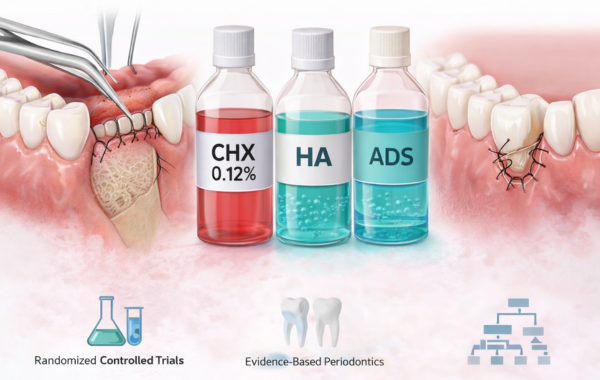
Periodontal wound healing following surgical or non-surgical therapy remains a clinical challenge, and adjunctive mouthrinses are commonly prescribed to enhance tissue repair and control biofilm accumulation. Chlorhexidine is considered the gold standard for chemical plaque control; however, adverse effects such as tooth staining have prompted the development of modified formulations, including hyaluronic acid and anti-discoloration systems (ADS). This systematic review and meta-analysis aimed to compare the effectiveness of chlorhexidine-based mouthwashes, hyaluronic acid formulations, and anti-discoloration systems versus other rinses on periodontal healing outcomes. A comprehensive electronic search was conducted in accordance with PRISMA 2020 guidelines, and randomized controlled trials were included. The protocol was prospectively registered in PROSPERO (CRD42024616667). Risk of bias was assessed using the Cochrane RoB 2 tool, and certainty of evidence was evaluated with the GRADE approach. Of 339 records screened, five trials involving 242 participants met the eligibility criteria. Outcomes included gingival healing indices, plaque index, bleeding scores, and dental pigmentation. While individual studies reported clinical improvements within intervention groups, pooled analyses showed small and non-statistically significant effects across healing, plaque, and bleeding outcomes. Overall certainty of evidence ranged from low to moderate due to heterogeneity and limited sample sizes. Current evidence suggests comparable short-term effectiveness among these formulations, without clear superiority of any specific regimen for periodontal healing.
Descargas
Referencias
Nazir M, Al-Ansari A, Al-Khalifa K, Alhareky M, Gaffar B, Almas K. Global prevalence of periodontal disease and lack of its surveillance. ScientificWorldJournal.2020;2020:2146160. https://doi.org/10.1155/2020/2146160 DOI: https://doi.org/10.1155/2020/2146160
Kwon T, Lamster IB, Levin L. Current concepts in the management of periodontitis. Int Dent J. 2021;71(6):462-476. https://doi.org/10.1111/idj.12630 DOI: https://doi.org/10.1111/idj.12630
Haas AN, Furlaneto FAC, Gaio EJ, Gomes SC, Palioto DB, Castilho RM, et al. New tendencies in non-surgical periodontal therapy. Braz Oral Res. 2021;35(suppl 2):e095. https://doi.org/10.1590/1807-3107bor-2021.vol35.0095 DOI: https://doi.org/10.1590/1807-3107bor-2021.vol35.0095
Wikesjö UM, Selvig KA. Periodontal wound healing and regeneration. Periodontol 2000. 1999;19:21-39. https://doi.org/10.1111/j.1600-0757.1999.tb00148.x DOI: https://doi.org/10.1111/j.1600-0757.1999.tb00145.x
Polimeni G, Xiropaidis AV, Wikesjö UM. Biology and principles of periodontal wound healing/regeneration. Periodontol 2000. 2006;41:30-47. https://doi.org/10.1111/j.1600-0757.2006.00157.x DOI: https://doi.org/10.1111/j.1600-0757.2006.00157.x
Marini L, Sahrmann P, Rojas MA, Cavalcanti C, Pompa G, Papi P, et al. Early wound healing score (EHS): an intra- and inter-examiner reliability study. Dent J (Basel). 2019;7(3):86. https://doi.org/10.3390/dj7030086 DOI: https://doi.org/10.3390/dj7030086
Szpaderska AM, Walsh CG, Steinberg MJ, DiPietro LA. Distinct patterns of angiogenesis in oral and skin wounds. J Dent Res. 2005;84(4):309-314. https://doi.org/10.1177/154405910508400403 DOI: https://doi.org/10.1177/154405910508400403
Werfully S, Areibi G, Toner M, Bergquist J, Walker J, Renvert S, et al. Tensile strength, histological and immunohistochemical observations of periodontal wound healing in the dog. J Periodontal Res. 2002;37(5):366-374. https://doi.org/10.1034/j.1600-0765.2002.00663.x DOI: https://doi.org/10.1034/j.1600-0765.2002.01375.x
Cortellini P, Labriola A, Zambelli R, Prato GP, Nieri M, Tonetti MS. Chlorhexidine with an anti-discoloration system after periodontal flap surgery: a cross-over, randomized, triple-blind clinical trial. J Clin Periodontol. 2008;35(7):614-620. https://doi.org/10.1111/j.1600-051X.2008.01238.x DOI: https://doi.org/10.1111/j.1600-051X.2008.01238.x
Sijari Z, Romano F, Ciardo G, Martella V, Maggiora M, Bottone M, et al. Effect of two post-surgical cleansing protocols on early periodontal wound healing and cytokine levels following osseous resective surgery: a randomized controlled study. Int J Dent Hyg. 2019;17(4):300-308. https://doi.org/10.1111/idh.12402 DOI: https://doi.org/10.1111/idh.12395
Berchier CE, Slot DE, Van der Weijden GA. The efficacy of 0.12% chlorhexidine mouthrinse compared with 0.2% on plaque accumulation and periodontal parameters: a systematic review. J Clin Periodontol. 2010;37(9):829-839. https://doi.org/10.1111/j.1600-051X.2010.01575.x DOI: https://doi.org/10.1111/j.1600-051X.2010.01575.x
Pilloni A, Annibali S, Dominici F, Di Paolo C, Papa M, Cassini MA, et al. Evaluation of the efficacy of an hyaluronic acid-based biogel on periodontal clinical parameters. A randomized-controlled clinical pilot study. Ann Stomatol (Roma). 2011;2(3-4):3-9. https://www.ncbi.nlm.nih.gov/pmc/articles/PMC3265098/
Carlson GA, Dragoo JL, Samimi B, Bruckner DA, Bernard GW, Hedrick MH, et al. Bacteriostatic properties of biomatrices against common orthopaedic pathogens. Biochem Biophys Res Commun. 2004;321(2):472-478. https://doi.org/10.1016/j.bbrc.2004.06.163 DOI: https://doi.org/10.1016/j.bbrc.2004.06.165
Kang JH, Kim YY, Chang JY, Kho HS. Influences of hyaluronic acid on the anticandidal activities of lysozyme and the peroxidase system. Oral Dis. 2011;17(6):577-583. https://doi.org/10.1111/j.1601-0825.2011.01803.x DOI: https://doi.org/10.1111/j.1601-0825.2011.01807.x
Sasaki T, Watanabe C. Stimulation of osteoinduction in bone wound healing by high-molecular-weight hyaluronic acid. Bone. 1995;16(1):9-15. https://doi.org/10.1016/8756-3282(94)00092-F DOI: https://doi.org/10.1016/8756-3282(95)80005-B
Dahiya P, Kamal R. Hyaluronic acid: a boon in periodontal therapy. N Am J Med Sci. 2013;5(5):309-315. https://doi.org/10.4103/1947-2714.112473 DOI: https://doi.org/10.4103/1947-2714.112473
Deed R, Rooney P, Kumar P, Norton JD, Smith J, Freemont AJ, et al. Early-response gene signalling is induced by angiogenic oligosaccharides of hyaluronan in endothelial cells. Inhibition by non-angiogenic, high-molecular-weight hyaluronan. Int J Cancer. 1997;71(2):251-256. https://doi.org/10.1002/(SICI)1097-0215(19970410)71:2 DOI: https://doi.org/10.1002/(SICI)1097-0215(19970410)71:2<251::AID-IJC21>3.0.CO;2-J
Prosdocimi M, Bevilacqua C. Exogenous hyaluronic acid and wound healing: an updated vision. Panminerva Med. 2012;54(2):129-135. https://www.minervamedica.it/en/journals/panminerva-medica/article.php?cod=R83Y2012N02A0129
World Medical Association. World Medical Association Declaration of Helsinki: ethical principles for medical research involving human subjects. JAMA. 2013;310(20):2191-2194. https://doi.org/10.1001/jama.2013.281053 DOI: https://doi.org/10.1001/jama.2013.281053
Graziani F, Izzetti R, Perić M, Marhl U, Nisi M, Gennai S. Early periodontal wound healing after chlorhexidine rinsing: a randomized clinical trial. Clin Oral Investig. 2024;28(6):354. https://doi.org/10.1007/s00784-024-05542-1 DOI: https://doi.org/10.1007/s00784-024-05643-0
Trombelli L, Simonelli A, Pramstraller M, Guarnelli ME, Fabbri C, Maietti E, et al. Clinical efficacy of a chlorhexidine-based mouthrinse containing hyaluronic acid and an antidiscoloration system in patients undergoing flap surgery: a triple-blind, parallel-arm, randomized controlled trial. Int J Dent Hyg. 2018;16(4):541-552. https://doi.org/10.1111/idh.12348 DOI: https://doi.org/10.1111/idh.12361
Fischer RG, Lira Junior R, Retamal-Valdes B, Figueiredo LC, Malheiros Z, Stewart B, et al. Periodontal disease and its impact on general health in Latin America. Section V: treatment of periodontitis. Braz Oral Res. 2020;34(suppl 1):e026. https://doi.org/10.1590/1807-3107bor-2020.vol34.0026 DOI: https://doi.org/10.1590/1807-3107bor-2020.vol34.0026
Rodríguez Y, Valera J, Echevarría M, Mija J, Chale A, Bravo F, et al. Terapia periodontal inicial. Efectividad del control de placa bacteriana: revisión bibliográfica. APPO Rev Cient. 2016;1(1). https://appo.com.pe/wp-content/uploads/2016/11/Terapia-periodontal-inicial.-Efectividad-del-control-de-placa-bacteriana-Revisi%C3%B3n-Bibliogr%C3%A1fica.pdf
Graziani F, Gennai S, Cei S, Cairo F, Baggiani A, Miccoli M, et al. Clinical performance of access flap surgery in the treatment of the intrabony defect: a systematic review and meta-analysis of randomized clinical trials. J Clin Periodontol. 2012;39(2):145-156. https://doi.org/10.1111/j.1600-051X.2011.01815.x DOI: https://doi.org/10.1111/j.1600-051X.2011.01815.x
Needleman I, Worthington HV, Giedrys-Leeper E, Tucker R. Guided tissue regeneration for periodontal infra-bony defects. Cochrane Database Syst Rev. 2006;(2):CD001724. https://doi.org/10.1002/14651858.CD001724.pub2 DOI: https://doi.org/10.1002/14651858.CD001724.pub2
Meza C, Palomo E, Trujillo L, Martinez J, Acuña Y, Meza C, et al. Efecto cicatrizante en incisiones periodontales por extracto hidroalcohólico de Morinda citrifolia. Vive Rev Salud. 2023;6(17):464-481. https://www.scielo.org.bo/scielo.php?script=sci_arttext&pid=S2664-32432023000200464 DOI: https://doi.org/10.33996/revistavive.v6i17.238
Abdulkareem AA, Al Marah ZA, Abdulbaqi HR, Alshaeli AJ, Milward MR. A randomized double-blind clinical trial to evaluate the efficacy of chlorhexidine, antioxidant, and hyaluronic acid mouthwashes in the management of biofilm-induced gingivitis. Int J Dent Hyg. 2020;18(3):268-277. https://doi.org/10.1111/idh.12471 DOI: https://doi.org/10.1111/idh.12432
Shah H, Shah K, Kiran SK, Pebdillia S, Kumar Yadav R, Bavesh K, et al. A prospective, open label, double arm, multi-center, comparative clinical study on mouth rinse containing chlorhexidine and hyaluronic acid as a potential aid in improving overall gum health in patients, post oral surgical procedures. Int J Dent Med Sci Res. 2024;6(6):199–211. https://doi.org/10.35629/5252-0606199211
Genovesi A, Barone A, Toti P, Covani U. The efficacy of 0.12% chlorhexidine versus 0.12% chlorhexidine plus hyaluronic acid mouthwash on healing of submerged single implant insertion areas: a short-term randomized controlled clinical trial. Int J Dent Hyg. 2015;12(3):214–222. https://doi.org/10.1111/idh.12158 DOI: https://doi.org/10.1111/idh.12158
Lorenzini G, Picciotti M, Giovannardi M, Viviano M. Comparison between two different chlorhexidine-based mouthwashes in oral surgery. Dental Cadmos. 2014;82(9):642–648. https://doi.org/10.1016/S0011-8524(14)70230-2 DOI: https://doi.org/10.1016/S0011-8524(14)70230-2
Eliezer M, Imber JC, Sculean A, Pandis N, Teich ST. Hyaluronic acid as adjunctive to non-surgical and surgical periodontal therapy: a systematic review and meta-analysis. Clin Oral Investig. 2019;23(9):3423-3435. https://doi.org/10.1007/s00784-019-02898-9 DOI: https://doi.org/10.1007/s00784-019-03012-w
Pilloni A, Marini L, Gagliano N, Canciani E, Dellavia C, Cornaghi L, et al. Clinical, histological, immunohistochemical, and biomolecular analysis of hyaluronic acid in early wound healing of human gingival tissues: a randomized, split-mouth trial. J Periodontol. 2023;94(7):868-881. https://doi.org/10.1002/JPER.22-0367 DOI: https://doi.org/10.1002/JPER.22-0338
Descargas
Publicado
Declaración de disponibilidad de datos
The datasets generated and analyzed during the current study are available from the corresponding author upon reasonable request.
Número
Sección
Categorías
Licencia
Derechos de autor 2026 Jorge Oscar Espejo-Zuñiga, María Victoria Espinoza-Salcedo, Augusto Alberto Aguirre-Aguilar (Autor/a)

Esta obra está bajo una licencia internacional Creative Commons Atribución 4.0.
Authors retain the copyright of their work and grant TUMI Oral Health the right of first publication. Articles are published under the Creative Commons Attribution 4.0 International License (CC BY 4.0), which permits unrestricted use, distribution, and reproduction in any medium, provided that the original work is properly cited.