Music listening and dental anxiety in children aged 4–8 years: a quasi-experimental study
DOI:
https://doi.org/10.64716/297txm60Keywords:
Dental Anxiety, Music, Child, Child, Preschool, Pediatric DentistryAbstract
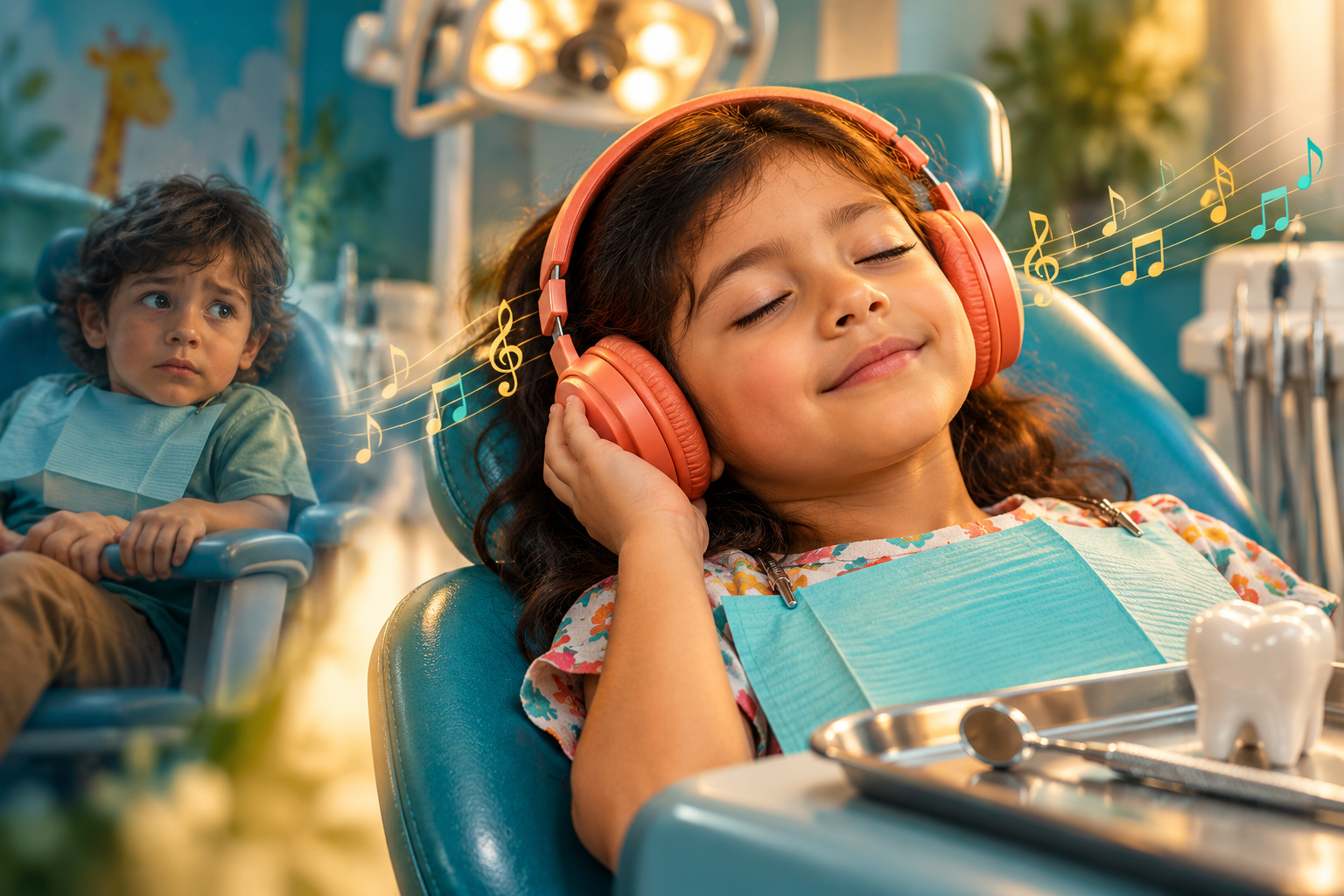
Background: Music listening may complement behavior guidance during pediatric dental care. Objective: To describe anxiety before and after treatment with and without music, and examine distributions by age and music genre. Methods: A nonrandomized controlled study included 64 children aged 4–8 years recruited by convenience in Trujillo, Peru, in 2025: 32 with music and 32 without music. Anxiety was assessed with the Facial Image Scale. Age and genre distributions were compared using two-sided Fisher–Freeman–Halton exact tests. Results: After treatment, the music group comprised 17 children with mild anxiety (53.1%) and 15 with mild-to-moderate anxiety (46.9%). The within-group before-and-after comparisons yielded p = 0.0015 with music and p = 0.862 without music. The exploratory comparison at age 5 yielded p = 0.0357. Mild anxiety occurred in 15 of 17 children receiving classical music (88.2%) and 6 of 15 receiving children’s music (40.0%); the genre comparison yielded p = 0.0098. Conclusions: Lower anxiety categories were observed after treatment with music. Classical music was associated with a more favorable anxiety distribution than children’s music. Nonrandomized allocation limits causal interpretation; age findings remain exploratory. Trial registration: Not reported in the study documentation.
Downloads
References
Grisolia BM, Dos Santos APP, Dhyppolito IM, Buchanan H, Hill K, Oliveira BH. Prevalence of dental anxiety in children and adolescents globally: A systematic review with meta-analyses. Int J Paediatr Dent. 2021;31(2):168-183.
https://doi.org/10.1111/ipd.12712 DOI: https://doi.org/10.1111/ipd.12712
Shindova MP, Belcheva AB. Dental fear and anxiety in children: a review of the environmental factors. Folia Med (Plovdiv). 2021;63(2):177-182.
https://doi.org/10.3897/folmed.63.e54763 DOI: https://doi.org/10.3897/folmed.63.e54763
Lima DSM, Barreto KA, Rank RCIC, Vilela JER, Corrêa MSNP, Colares V. Does previous dental care experience make the child less anxious? An evaluation of anxiety and fear of pain. Eur Arch Paediatr Dent. 2021;22(2):139-143.
https://doi.org/10.1007/s40368-020-00527-9 DOI: https://doi.org/10.1007/s40368-020-00527-9
Dhar V, Jayaraman J, Marghalani AA, Wells M, Randall CL, Law C, Majstorović M, Gosnell E, Townsend J, Chen CY, Wedeward R. Nonpharmacological Behavior Guidance For Children During Dental Treatment Visits: A Systematic Review and Meta-Analysis-Part 2. Pediatr Dent. 2023;45(3):197-220.
https://pubmed.ncbi.nlm.nih.gov/37381122/
Dhar V, Gosnell E, Jayaraman J, Law C, Majstorović M, Marghalani AA, Randall CL, Townsend J, Wells M, Chen CY, Wedeward R. Nonpharmacological Behavior Guidance for the Pediatric Dental Patient. Pediatr Dent. 2023;45(5):385-410.
https://pubmed.ncbi.nlm.nih.gov/37904260/
Passos De Luca M, Massignan C, Bolan M, Butini Oliveira L, Aydinoz S, Dick B, De Luca Canto G. Does the presence of parents in the dental operatory room influence children's behaviour, anxiety and fear during their dental treatment? A systematic review. Int J Paediatr Dent. 2021;31(3):318-336.
https://doi.org/10.1111/ipd.12762 DOI: https://doi.org/10.1111/ipd.12762
Tan K, Liu H, Huang S, Li C. Efficacy of Music Intervention for Dental Anxiety Disorders: A Systematic Review and Meta-Analysis. Medicina (Kaunas). 2023;59(2):209.
https://doi.org/10.3390/medicina59020209 DOI: https://doi.org/10.3390/medicina59020209
Shih KC, Hsu WT, Yang JL, Man KM, Chen KB, Lin WY. The Effect of Music Distraction on Dental Anxiety During Invasive Dental Procedures in Children and Adults: A Meta-Analysis. J Clin Med. 2024;13(21):6491.
https://doi.org/10.3390/jcm13216491 DOI: https://doi.org/10.3390/jcm13216491
Marqués-Martínez L, Andrés J, García-Miralles E, Borell-García C, Aura-Tormos JI, Barona CG. Music Therapy for Managing Dental Anxiety in Children: A Systematic Review and Meta-Analysis of Clinical Evidence. Children (Basel). 2025;12(10):1382.
https://doi.org/10.3390/children12101382 DOI: https://doi.org/10.3390/children12101382
Buchanan H, Niven N. Validation of a Facial Image Scale to assess child dental anxiety. Int J Paediatr Dent. 2002;12(1):47-52.
https://doi.org/10.1046/j.0960-7439.2001.00322.x DOI: https://doi.org/10.1046/j.0960-7439.2001.00322.x
Tiwari S, Kulkarni P, Agrawal N, Mali S, Kale S, Jaiswal N. Dental Anxiety Scales Used in Pediatric Dentistry: A Systematic Review and Meta-analysis. J Contemp Dent Pract. 2021;22(11):1338-1345.
https://doi.org/10.5005/jp-journals-10024-3229 DOI: https://doi.org/10.5005/jp-journals-10024-3229
Des Jarlais DC, Lyles C, Crepaz N, TREND Group. Improving the reporting quality of nonrandomized evaluations of behavioral and public health interventions: the TREND statement. Am J Public Health. 2004;94(3):361-6.
https://doi.org/10.2105/ajph.94.3.361 DOI: https://doi.org/10.2105/AJPH.94.3.361
Hoffmann TC, Glasziou PP, Boutron I, Milne R, Perera R, Moher D, Altman DG, Barbour V, Macdonald H, Johnston M, Lamb SE, Dixon-Woods M, McCulloch P, Wyatt JC, Chan AW, Michie S. Better reporting of interventions: template for intervention description and replication (TIDieR) checklist and guide. BMJ. 2014;348:g1687
https://doi.org/10.1136/bmj.g1687 DOI: https://doi.org/10.1136/bmj.g1687
World Medical Association. World Medical Association Declaration of Helsinki: ethical principles for medical research involving human subjects. JAMA. 2013;310(20):2191-4.
https://doi.org/10.1001/jama.2013.281053 DOI: https://doi.org/10.1001/jama.2013.281053
James J, Retnakumari N, Vadakkepurayil K, Thekkeveetil AK, Tom A. Effectiveness of Aromatherapy and Music Distraction in Managing Pediatric Dental Anxiety: A Comparative Study. Int J Clin Pediatr Dent. 2021;14(2):249-253
https://doi.org/10.5005/jp-journals-10005-1911 DOI: https://doi.org/10.5005/jp-journals-10005-1911
Janthasila N, Keeratisiroj O. Music therapy and aromatherapy on dental anxiety and fear: A randomized controlled trial. J Dent Sci. 2023;18(1):203-210.
https://doi.org/10.1016/j.jds.2022.06.008 DOI: https://doi.org/10.1016/j.jds.2022.06.008
Sadeghi M, Sarlak H, Nakhostin A, Almasi-Hashiani A. Which audio distraction technique is more effective for reduction the pain and anxiety of pediatric dental patients; "music" or "kids-story"? A randomized split-mouth crossover clinical trial. J Psychosom Res. 2023;168:111218.
https://doi.org/10.1016/j.jpsychores.2023.111218 DOI: https://doi.org/10.1016/j.jpsychores.2023.111218
Abdalhai R, Kouchaji C, Alkhatib R. The effect of aromatherapy with Lavender-Neroli oil and music in management of pediatric dental anxiety: a randomized control trial. BDJ Open. 2024;10(1):5.
https://doi.org/10.1038/s41405-024-00186-8 DOI: https://doi.org/10.1038/s41405-024-00186-8
Bhusari BN, Hugar SM, Gokhale N, Kajjari S, Karmarkar S, Sahai V. Binaural auditory beats vs music of choice as audio distraction behaviour guidance technique among children: A randomized controlled trial. J Oral Biol Craniofac Res. 2025;15(1):163-169.
https://doi.org/10.1016/j.jobcr.2024.12.019 DOI: https://doi.org/10.1016/j.jobcr.2024.12.019
Bhusari BN, Hugar SM, Kohli N, Karmarkar S, Gokhale N, Saxena N. Comparative evaluation of anxiety level during restorative treatment using no music, monaural beats, and binaural auditory beats as audio distraction behavior guidance technique in children aged 6-12 years: A randomized clinical trial. J Indian Soc Pedod Prev Dent. 2023;41(2):156-162.
https://doi.org/10.4103/jisppd.jisppd_104_23 DOI: https://doi.org/10.4103/jisppd.jisppd_104_23
Chawla T, Nangia T, Srivastava M, Kalra G, Langpoklakpam C. Comparative evaluation of effectiveness among various sensory distractors for reducing dental anxiety in pediatric population aged 6-9 years - A randomized controlled trial. J Indian Soc Pedod Prev Dent. 2025;43(1):104-110.
https://doi.org/10.4103/jisppd.jisppd_18_25 DOI: https://doi.org/10.4103/jisppd.jisppd_18_25
Bali K, Ailawadi R, Karuna YM, Srikant N, Rao A, Nayak PA, Thimmaiah C. Assessment of smartphone-based active distraction in association with audioanalgesia for overcoming airotor-related anxiety in children: a randomized controlled trial. BMC Res Notes. 2025;18(1):46.
https://doi.org/10.1186/s13104-025-07119-0 DOI: https://doi.org/10.1186/s13104-025-07119-0
Shehani F, Samuel V, Kavitha R, Mani R. Effectiveness of brainwave entrainment on pre-operative fear and anxiety in pediatric dental patients: a randomized controlled trial. Eur Arch Paediatr Dent. 2024;25(4):577-587.
https://doi.org/10.1007/s40368-024-00921-7 DOI: https://doi.org/10.1007/s40368-024-00921-7
Cunningham A, McPolin O, Fallis R, Coyle C, Best P, McKenna G. A systematic review of the use of virtual reality or dental smartphone applications as interventions for management of paediatric dental anxiety. BMC Oral Health. 2021;21(1):244.
https://doi.org/10.1186/s12903-021-01602-3 DOI: https://doi.org/10.1186/s12903-021-01602-3
Massignan C, Soares JP, Pires MMS, Dick B, Porporatti AL, Canto GL, Bolan M. Parental acceptance toward behavior guidance techniques for pediatric dental visits: a meta-analysis. Braz Oral Res. 2022;36:e0127.
https://doi.org/10.1590/1807-3107bor-2022.vol36.0127 DOI: https://doi.org/10.1590/1807-3107bor-2022.vol36.0127
Downloads
Published
Data Availability Statement
The aggregate data underlying the reported analyses are presented in Tables 1–3. Reasonable requests for access to de-identified study records should be addressed to the corresponding author and are subject to institutional authorization and applicable ethical and confidentiality restrictions. Records containing personal identifiers will not be shared.
Issue
Section
Categories
License
Copyright (c) 2026 Viviana Meylin Torres-Paredes, Katia Noemi Rubio-Membrillo, Juan Carlos Hernández-Cabanillas, Ivan Olivares-Acosta (Autor/a)

This work is licensed under a Creative Commons Attribution 4.0 International License.
Authors retain the copyright of their work and grant TUMI Oral Health the right of first publication. Articles are published under the Creative Commons Attribution 4.0 International License (CC BY 4.0), which permits unrestricted use, distribution, and reproduction in any medium, provided that the original work is properly cited.