
Relationship between physical activity and comprehensive development in early childhood education according to teachers' perceptions
DOI:
https://doi.org/10.64716/a4bajp79Keywords:
Physical Activity, Child Development, Child, Preschool, Early Childhood Education, TeachersAbstract
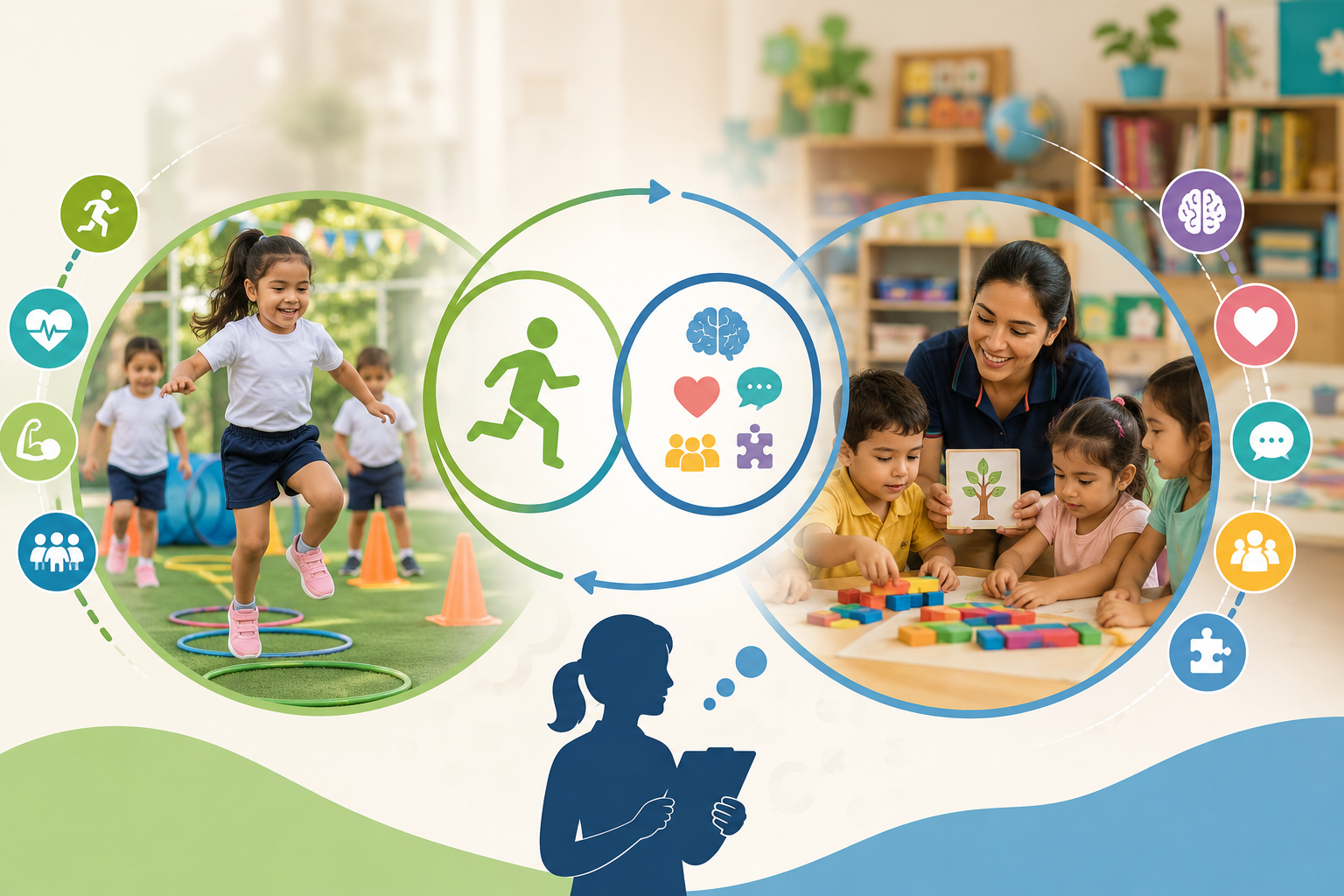
Background: Physical activity during early childhood is an important component of healthy growth and may contribute to motor, cognitive, social, and emotional development. Understanding its relationship with children’s holistic development may support educational practices aimed at promoting well-being from the preschool stage. Objective: To determine the association between physical activity and holistic development in preschool children according to teachers’ perceptions. Methods: An observational, analytical, cross-sectional study with a quantitative approach was conducted. The entire accessible population of 50 preschool children aged 3 to 5 years was included using a census approach. Teachers assessed physical activity and holistic development using structured questionnaires with evidence of content validity and adequate internal consistency. Categorical variables were summarized using frequencies and percentages, and the association between the study variables was evaluated using the chi-square test, with statistical significance set at p < 0.05. Results: Physical activity was classified as fair in 46.0% of children, good in 46.0%, poor in 6.0%, and excellent in 2.0%. Holistic development was predominantly moderate (70.0%), followed by high (26.0%) and low (4.0%) levels. No statistically significant association was found between physical activity and holistic development (p = 0.070). Conclusions: Physical activity and holistic development were not significantly associated according to teachers’ perceptions. Nevertheless, both represent relevant components of preschool development and should be considered within comprehensive educational strategies for early childhood.
Downloads
References
World Health Organization. Guidelines on physical activity, sedentary behaviour and sleep for children under 5 years of age [Internet]. Geneva: World Health Organization; 2019 [cited 2026 Aug 12]. Available from: https://www.who.int/publications/i/item/9789241550536
Schmutz EA, Leeger-Aschmann CS, Kakebeeke TH, Zysset AE, Messerli-Bürgy N, Stülb K, et al. Motor competence and physical activity in early childhood: stability and relationship. Front Public Health. 2020;8:39. https://doi.org/10.3389/fpubh.2020.00039
United Nations Educational, Scientific and Cultural Organization. Quality physical education (QPE): guidelines for policy-makers [Internet]. Paris: UNESCO; 2015 [cited 2026 Aug 12]. Available from: https://unesdoc.unesco.org/ark:/48223/pf0000231101
World Health Organization. Improving early childhood development: WHO guideline [Internet]. Geneva: World Health Organization; 2020 [cited 2026 Aug 12]. Available from: https://www.who.int/publications/i/item/97892400020986
Jylänki P, Mbay T, Hakkarainen A, Sääkslahti A, Aunio P. The effects of motor skill and physical activity interventions on preschoolers' cognitive and academic skills: a systematic review. Prev Med. 2022;155:106948. https://doi.org/10.1016/j.ypmed.2021.106948
Morales JS, Alberquilla del Río E, Valenzuela PL, Martínez-de-Quel Ó. Physical activity and cognitive performance in early childhood: a systematic review and meta-analysis of randomized controlled trials. Sports Med. 2024;54(7):1835-1850. https://doi.org/10.1007/s40279-024-02020-5
Saamong CRS, Deogracias PKE, Saltmarsh SO, Chan DKC, Capio CM. Early childhood teachers' perceptions of physical activity: a scoping review. Early Child Educ J. 2025;53(1):73-85. https://doi.org/10.1007/s10643-023-01575-8
Rech JP, Chaudhary P, Schenkelberg M, Dinkel D. A convergent mixed methods study to explore physical activity among teachers and children during the preschool day. Early Child Educ J. 2024;52(4):793-802. https://doi.org/10.1007/s10643-023-01486-8
Jerebine A, Heering T, Barnett LM. Educator-perceived barriers and facilitators to structured-physical activity in early childhood centres: a systematic review. Res Q Exerc Sport. 2024;95(1):243-262. https://doi.org/10.1080/02701367.2023.2193243
Taylor N, Pringle A, Roscoe CMP. Characteristics of the outdoor environment affording physical activity, motor competence, and social interactions in children aged 3-7 years: a systematic review. Children (Basel). 2024;11(12):1491. https://doi.org/10.3390/children11121491
von Elm E, Altman DG, Egger M, Pocock SJ, Gøtzsche PC, Vandenbroucke JP; STROBE Initiative. The Strengthening the Reporting of Observational Studies in Epidemiology (STROBE) statement: guidelines for reporting observational studies. PLoS Med. 2007;4(10):e296. https://doi.org/10.1371/journal.pmed.0040296
World Medical Association. World Medical Association Declaration of Helsinki: ethical principles for medical research involving human participants. JAMA. 2025;333(1):71-74. https://doi.org/10.1001/jama.2024.21972
D'Cruz AFL, D'Souza NJ, Downing KL, Smith C, Sciberras E, Hesketh KD. Association between physical activity and self-regulation in early childhood: a systematic review. Obes Rev. 2024;25(2):e13657. https://doi.org/10.1111/obr.13657
Aadland KN, Lervåg A, Andersen JR, Howard SJ, Ommundsen Y, Aadland E. Effects of a staff physical activity professional development intervention on preschoolers' mental health and self-regulation: the Active Learning Norwegian Preschool(er)s (ACTNOW) cluster randomised controlled trial. Psychol Sport Exerc. 2024;75:102705. https://doi.org/10.1016/j.psychsport.2024.102705
Haugland ES, Nilsen AKO, Vabø KB, Pesce C, Bartholomew J, Okely AD, et al. Effects of a staff-led multicomponent physical activity intervention on preschooler's fundamental motor skills and physical fitness: the ACTNOW cluster-randomized controlled trial. Int J Behav Nutr Phys Act. 2024;21(1):69. https://doi.org/10.1186/s12966-024-01616-4
Caldwell HAT, Spencer RA, Joshi N, Branje K, Cawley J, Hobson H, et al. Impact of an outdoor loose parts play intervention on Nova Scotian preschoolers' physical literacy: a mixed-methods randomized controlled trial. BMC Public Health. 2023;23(1):1126. https://doi.org/10.1186/s12889-023-16030-x
He Q, Ha ASC, Zheng B, Okely AD. Feasibility and potential efficacy of a family-based intervention on promoting physical activity levels and fundamental movement skills in preschoolers: a cluster randomised controlled trial. Appl Psychol Health Well Being. 2024;16(3):1266-1288. https://doi.org/10.1111/aphw.12527
Bai M, Lin N, Yu JJ, Teng Z, Xu M. The effect of planned active play on the fundamental movement skills of preschool children. Hum Mov Sci. 2024;96:103241. https://doi.org/10.1016/j.humov.2024.103241
Wang X, Zhou B. Motor development-focused exercise training enhances gross motor skills more effectively than ordinary physical activity in healthy preschool children: an updated meta-analysis. Front Public Health. 2024;12:1414152. https://doi.org/10.3389/fpubh.2024.1414152
Grady A, Lorch R, Giles L, Lamont H, Anderson A, Pearson N, et al. The impact of early childhood education and care-based interventions on child physical activity, anthropometrics, fundamental movement skills, cognitive functioning, and social-emotional wellbeing: a systematic review and meta-analysis. Obes Rev. 2025;26(2):e13852. https://doi.org/10.1111/obr.13852
Zhang J, Sloss IM, Maguire N, Browne DT. Physical activity and social-emotional learning in Canadian children: multilevel perspectives within an early childhood education and care setting. Social and Emotional Learning: Research, Practice, and Policy. 2024;4:100069. https://doi.org/10.1016/j.sel.2024.100069
Martinez-Merino N, Rico-González M. Effects of physical education on preschool children's physical activity levels and motor, cognitive, and social competences: a systematic review. J Teach Phys Educ. 2024;43(4):696-706. https://doi.org/10.1123/jtpe.2023-0183
Downloads
Published
Data Availability Statement
The anonymized dataset supporting the findings of this study is available from the corresponding author upon reasonable and justified academic request. The data have not been made publicly available because the study involved preschool children, and public disclosure could potentially compromise the confidentiality of the participants and the participating educational institution. Access to the dataset will therefore be subject to appropriate confidentiality and ethical safeguards.
Issue
Section
License
Copyright (c) 2026 Lady Briggith Gil-Sagastegui, Mayte Sandoval-Lavado, Maricielo Aylin Ciudad-Mozo, Soveida Haraminda Lalangui Neyra (Autor/a)

This work is licensed under a Creative Commons Attribution 4.0 International License.
Authors retain copyright and grant TUMI Health Sciences Research the right of first publication. Articles are published under the Creative Commons Attribution 4.0 International License (CC BY 4.0).