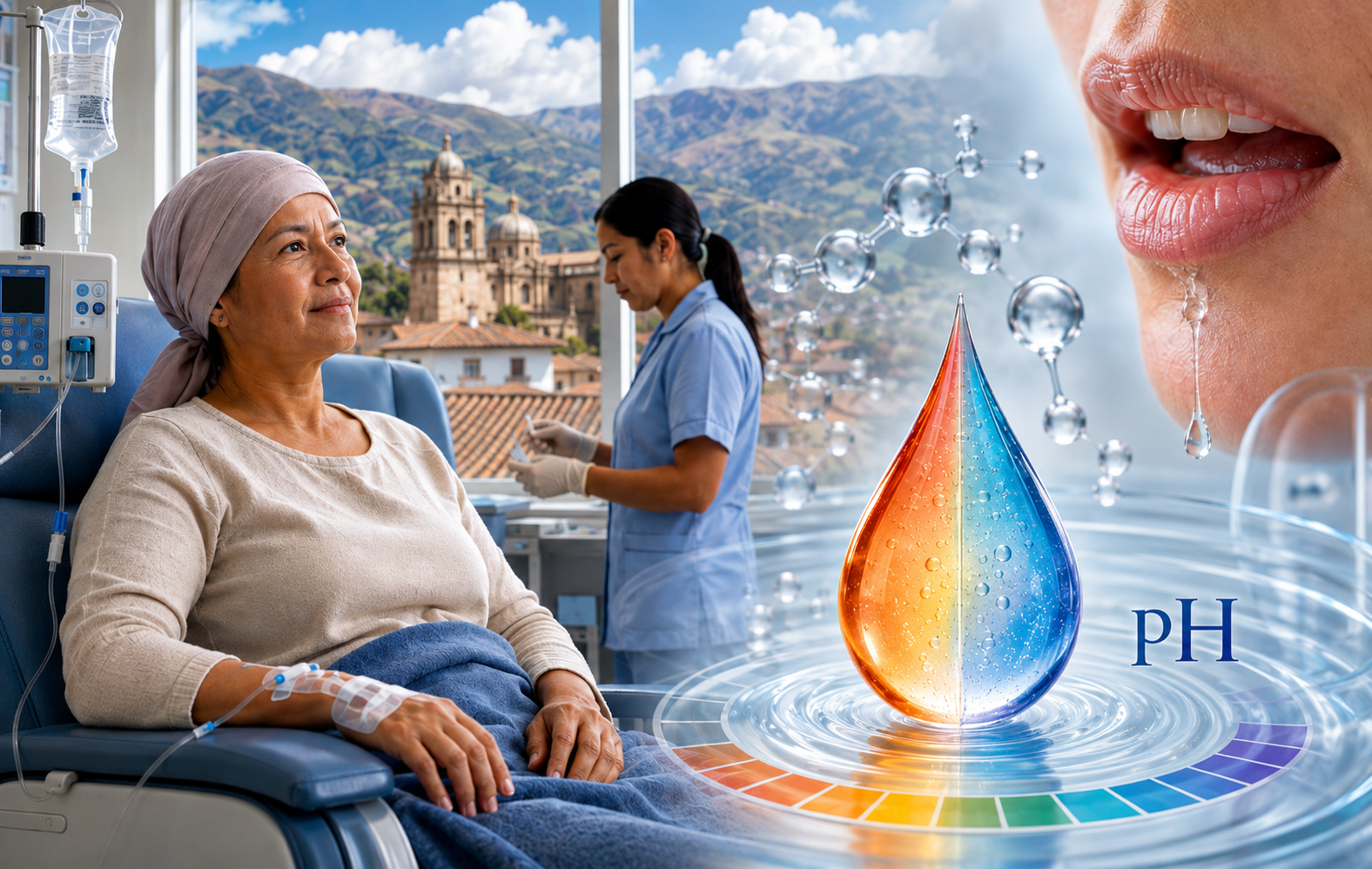
Chemotherapy and salivary pH in adults with cancer: an analytical cross-sectional study at a hospital in Cajamarca, Peru
DOI:
https://doi.org/10.64716/zp0zk802Keywords:
Neoplasms, Antineoplastic Agents, Saliva, Hydrogen-Ion Concentration, AdultAbstract
Introduction: Chemotherapy may disrupt salivary gland function and alter oral acid–base balance, increasing susceptibility to dental caries, infections, and mucosal complications. Objetive: This study aimed to determine the association between chemotherapy duration and salivary pH in adults with cancer treated at a hospital in Cajamarca, Peru. Methods: An observational, analytical, cross-sectional study with prospective data collection was conducted in 68 adults selected through convenience sampling. Chemotherapy duration was obtained from oncology medical records, and the pH of unstimulated whole saliva was measured using a calibrated digital pH meter. Associations were evaluated using the chi-square test in IBM SPSS Statistics version 27, with statistical significance established at p < 0.05. Results: Acidic salivary pH was identified in 58.8% of participants, neutral pH in 35.3%, and alkaline pH in 5.9%. Chemotherapy duration was significantly associated with salivary pH (p = 0.002); acidic pH was observed in 74.3% of patients treated for 6 months or longer, compared with 15.4% of those treated for up to 1 month. In stratified analyses, the association remained significant among women (p = 0.001) and adults aged 36–50 years (p = 0.002), but not among men (p = 0.356) or participants aged 18–35 years (p = 0.907). Conclusion: Longer chemotherapy exposure was associated with greater salivary acidification, supporting the inclusion of salivary monitoring in multidisciplinary oral care for adults receiving prolonged cancer treatment.
Downloads
References
Bray F, Laversanne M, Sung H, Ferlay J, Siegel RL, Soerjomataram I, et al. Global cancer statistics 2022: GLOBOCAN estimates of incidence and mortality worldwide for 36 cancers in 185 countries. CA Cancer J Clin. 2024;74(3):229-263. https://doi.org/10.3322/caac.21834
World Health Organization. Cancer. Updated April 16, 2026. Accessed June 26, 2026. https://www.who.int/news-room/fact-sheets/detail/cancer
Amjad MT, Chidharla A, Kasi A. Cancer chemotherapy. Updated February 27, 2023. In: StatPearls [Internet]. StatPearls Publishing; 2026. Accessed June 26, 2026. https://www.ncbi.nlm.nih.gov/books/NBK564367/
Hosseini MS, Sanaie S, Mahmoodpoor A, Jabbari Beyrami S, Jabbari Beyrami H, Fattahi S, et al. Cancer treatment-related xerostomia: basics, therapeutics, and future perspectives. Eur J Med Res. 2024;29(1):571. https://doi.org/10.1186/s40001-024-02167-x
Surdu A, Foia LG, Luchian I, Trifan D, Tatarciuc MS, Scutariu MM, et al. Saliva as a diagnostic tool for systemic diseases—a narrative review. Medicina (Kaunas). 2025;61(2):243. https://doi.org/10.3390/medicina61020243
Koppolu P, Sirisha S, Penala S, Reddy PK, Alotaibi DH, Abusalim GS, et al. Correlation of blood and salivary pH levels in healthy, gingivitis, and periodontitis patients before and after non-surgical periodontal therapy. Diagnostics (Basel). 2022;12(1):97. https://doi.org/10.3390/diagnostics12010097
Najafi S, Khayamzadeh M, Manifar S, Khaki A, Gholizadeh N. Changes in pH and sodium salivary bicarbonate among patients with acute myeloid leukemia before and after chemotherapy. Int J Cancer Manag. 2019;12(2):e83449. https://doi.org/10.5812/ijcm.83449
Acharya S, Pai KM, Bhat S, Mamatha B, Bejadi VM, Acharya S. Oral changes in patients undergoing chemotherapy for breast cancer. Indian J Dent Res. 2017;28(3):261-268. https://doi.org/10.4103/ijdr.IJDR_379_16
Paranjape MN, Shah P, Patil S, Shah R, Jagtap C, Lakade L. Assessment of the changes in the salivary profile and its clinical correlation in children with acute lymphoblastic leukemia undergoing chemotherapy: a follow-up study. Int J Clin Pediatr Dent. 2023;16(Suppl 3):S268-S271. https://doi.org/10.5005/jp-journals-10005-2692
Rani S, Singh K, Banipal RPS, Goyal G. Biochemical analysis of saliva in head and neck cancer patients receiving definitive chemoradiotherapy. J Cancer Res Ther. 2023;19(Suppl 2):S669-S676. https://doi.org/10.4103/jcrt.jcrt_692_22
Mahmood DM, Salih MA, Hamasoor TA. Effect of chemothereapy and radiotherapy on electrolyte level and pH of saliva in cancer patients with or without oral candidiasis in Sulaymani–Iraq. Thi-Qar Med J. 2023;26(2):62-73. https://doi.org/10.32792/tmj.v26i2.417
Ramya AS, Uppala D, Majumdar S, Surekha C, Deepak KGK. Are salivary amylase and pH—prognostic indicators of cancers? J Oral Biol Craniofac Res. 2015;5(2):81-85. https://doi.org/10.1016/j.jobcr.2015.04.002
Chaupe Huaripata WC. Flujo y nivel de pH salival en pacientes con cáncer de cabeza y cuello que reciben quimioterapias [tesis de pregrado]. Trujillo, Peru: Universidad Privada Antenor Orrego; 2024. https://hdl.handle.net/20.500.12759/32872
Hong C, Epstein JB, Jensen SB, Gueiros LA, van Leeuwen SJM, Kandwal A, et al. MASCC/ISOO Clinical Practice Statement: clinical assessment of salivary gland hypofunction and xerostomia in cancer patients. Support Care Cancer. 2024;32(8):551. https://doi.org/10.1007/s00520-024-08691-0
Von Elm E, Altman DG, Egger M, Pocock SJ, Gøtzsche PC, Vandenbroucke JP; STROBE Initiative. The Strengthening the Reporting of Observational Studies in Epidemiology statement: guidelines for reporting observational studies. Lancet. 2007;370(9596):1453-1457. https://doi.org/10.1016/S0140-6736(07)61602-X
Navazesh M, Kumar SKS. Measuring salivary flow: challenges and opportunities. J Am Dent Assoc. 2008;139(Suppl):35S-40S. https://doi.org/10.14219/jada.archive.2008.0353
AKSO Instruments. AK90 pH/Temp Tester. Accessed June 26, 2026. https://aksoinstruments.com/produto/ak90-ph-temperature-tester/
Mazzeo MA, Linares JA, Campos ML, Busamia BE, Dubersarsky C, Lavarda M, et al. Oral signs of intravenous chemotherapy with 5-fluorouracil and leucovorin calcium in colon cancer treatment. Med Oral Patol Oral Cir Bucal. 2009;14(3):E108-E113. https://www.medicinaoral.com/medoralfree01/v14i3/medoralv14i3p108.pdf
Jensen SB, Mouridsen HT, Reibel J, Brünner N, Nauntofte B. Adjuvant chemotherapy in breast cancer patients induces temporary salivary gland hypofunction. Oral Oncol. 2008;44(2):162-173. https://doi.org/10.1016/j.oraloncology.2007.01.015
Paz C, Glassey A, Frick A, Sattar S, Zaorsky NG, Blitzer GC, et al. Cancer therapy-related salivary dysfunction. J Clin Invest. 2024;134(17):e182661. https://doi.org/10.1172/JCI182661
Li Z, Wu Q, Meng X, Yu H, Jiang D, Chen G, et al. Oral pH value predicts the incidence of radiotherapy related caries in nasopharyngeal carcinoma patients. Sci Rep. 2021;11:12283. https://doi.org/10.1038/s41598-021-91600-w
Prodan A, Brand HS, Ligtenberg AJM, Imangaliyev S, Tsivtsivadze E, van der Weijden F, et al. Interindividual variation, correlations, and sex-related differences in the salivary biochemistry of young healthy adults. Eur J Oral Sci. 2015;123(3):149-157. https://doi.org/10.1111/eos.12182
Eliasson L, Birkhed D, Osterberg T, Carlén A. Minor salivary gland secretion rates and immunoglobulin A in adults and the elderly. Eur J Oral Sci. 2006;114(6):494-499. https://doi.org/10.1111/j.1600-0722.2006.00413.x
Parvinen T, Larmas M. Age dependency of stimulated salivary flow rate, pH, and lactobacillus and yeast concentrations. J Dent Res. 1982;61(9):1052-1055. https://doi.org/10.1177/00220345820610090501
Chaveli-López B. Oral toxicity produced by chemotherapy: a systematic review. J Clin Exp Dent. 2014;6(1):e81-e90. https://doi.org/10.4317/jced.51337
Downloads
Published
Data Availability Statement
The de-identified dataset and the corresponding variable coding used in this study are available from the corresponding author upon reasonable and justified request. Access will be provided in accordance with participant confidentiality, ethical approval conditions, and applicable institutional regulations
License
Copyright (c) 2026 Frida Hoyos-Sagastegui (Autor/a)

This work is licensed under a Creative Commons Attribution 4.0 International License.
Authors retain the copyright of their work and grant TUMI Oral Health the right of first publication. Articles are published under the Creative Commons Attribution 4.0 International License (CC BY 4.0), which permits unrestricted use, distribution, and reproduction in any medium, provided that the original work is properly cited.